Showing posts with label asparagus. Show all posts

Friday, May 13, 2016

Spring Vegetable Ramen

Last Year's Post:  Chicken with Shallots
Two Years Ago:   Pan-Seared Tuna with Capers and Red Wine Sauce

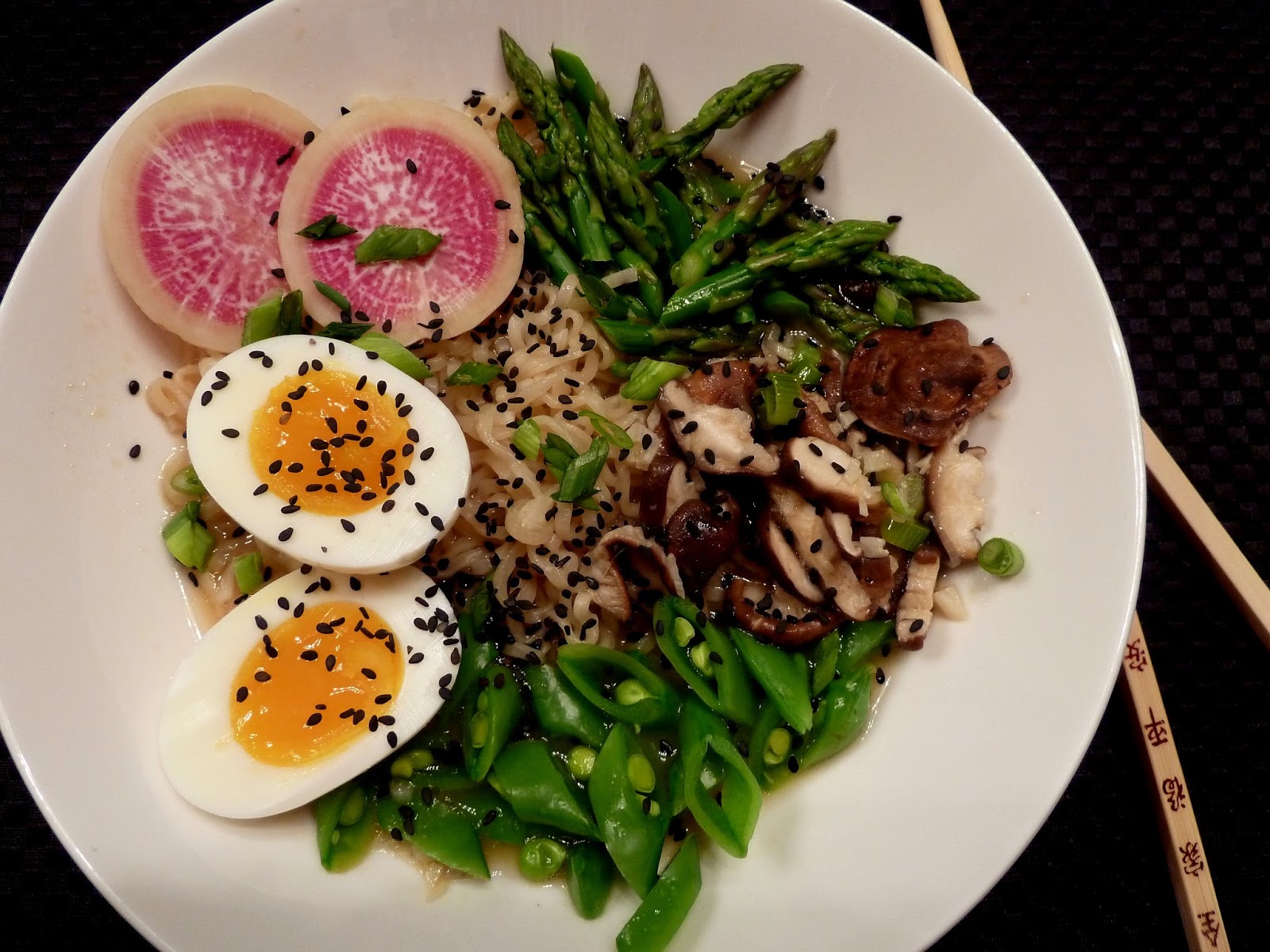
If you're looking for a light, healthy entree to counter-balance a heavy food episode or just want to cut down a little, give this recipe a try.  The broth is warming and fragrant with garlic, ginger and sesame, and the miso adds a deep umami flavor.  (You can usually find white miso - the mildest variety, near tofu at well-stocked supermarkets.  If you can't find it, the broth will be good anyway.)  The vegetables add nutrition and crunch,and the egg is great protein.  You could always add or substitute some shredded chicken for the egg if you want a more substantial meal.

I love the black sesame seeds for drama, but toasted white sesame seeds would work just as well.  And I couldn't resist adding the watermelon radish simply because I found one at the grocery store.  They're not all that easy to find but very pretty.  Funny story:  I thought the radish would stump the cashier for sure, but she just kept right on going and never missed a beat.  When I told her I thought it was going to stump her, she said "I've been a cashier for 25 years so I don't get stumped easily".  The woman in back of me said she'd never heard of a watermelon radish and the cashier told her it was also known as a shallot.  Not quite!  Shallots are mild onions, watermelon radishes are radishes.  Oh
well.


I've been reading a fair amount about how to hard-boil eggs lately because I've had trouble with the shells sticking and ripping up the whites.  Turns out the best tip is to boil the water first, then gently lower in the eggs.  Cook 6 minutes for soft-boiled (runny yolk) or 8 minutes for hard-boiled (hard yolk), then immediately place in an ice bath to stop the cooking process.  Works really well - the shells don't stick at all.

Spring Vegetable Ramen
Serves 4

4 eggs
1 bunch slender asparagus, trimmed
6 ounces sugar snap peas, trimmed
2 tablespoons toasted sesame oil, divided
1 bunch green onions, sliced, white and green parts separated
4 cloves garlic, minced
1 tablespoon grated fresh ginger
2 cups water
2 cups chicken broth
3 tablespoons white miso
1 ½ tablespoons reduced-sodium soy sauce
4 ounces fresh shiitake mushrooms, stemmed and sliced
2 (3 ounce) packages ramen noodle soup, seasoning packets discarded
Black or white sesame seeds, for garnish (optional)
Sliced watermelon radish, for garnish (optional)

Hard-cook the eggs:  fill a saucepan with enough water to cover the eggs and bring to a boil, then gently lower the eggs into the water.  Reduce heat, cover, and let simmer for 8 minutes.  Remove the eggs and immediately place in a bowl filled with ice water to stop the cooking process.  When completely cool, remove and pat dry.  Shell the eggs and cut in half.

Cut the tips off the asparagus, then cut the spears into 1” lengths.  Bring a large pot of water to a boil and add the asparagus spears.  Let boil for 1 minute, then add the asparagus tips and the sugar snap peas.  Boil an additional 30 seconds, then remove all with a slotted spoon and place in an ice water bath (save the water and keep it hot).  When cool, remove the vegetables from the water and pat dry.  Slice the sugar snap peas diagonally into 3-4 pieces each.  Set aside.

In a large saucepan, heat 1 tablespoon oil over medium heat.  Add green onion whites, garlic and ginger and cook, stirring, until fragrant, about 1 minute.  Add water, chicken broth, miso, soy sauce and the remaining 1 tablespoon oil, bring to a rolling simmer.  Add the mushrooms and simmer for 3 to 5 minutes.

Meanwhile, place the ramen noodles in the boiling water left from cooking the vegetables.  Cook, stirring occasionally, for 3 minutes until soft.  Drain.

To serve, divide the ramen noodles between wide shallow bowls.  Ladle in the broth mixture and mushrooms, then top with asparagus and sugar snap peas.  Garnish each bowl with 2 eggs halves, sesame seeds and watermelon radish slices.  Top with green onion tops and serve.


Friday, March 25, 2016

Spring Green Pasta

Last Year's Post: Citizen Public House Chopped Salad
Two Years Ago:   Lentil Salad with Bacon and Walnuts

Pasta Primavera is a great classic spring dish filled with bright vegetables.  The standard version often has a cream-based sauce which seems counter to the light, fresh feeling of the dish - a fragrant basil pesto seems better suited to the spring spirit.  I decided not to call this Pesto Pasta Primavera, however, because that level of alliteration seemed pretty annoying.

The good news is that you can make this dish before spring vegetables are actually available locally, using fresh produce from the store.  Then you can make it again using produce from the local farmer's market in a month or two.  I like the fact that it's vegetarian, but you could certainly add some cooked chicken or turkey if you want.  It's a fast, easy and healthy dish to get you in the mood for spring - you just do a fast vegetable saute while the pasta is cooking.


About the pesto: feel free to make your favorite recipe or buy some at the store.  A friend of mine introduced me to Costco's pesto sauce, which is excellent but like everything else at Costco comes in a large jar.  I divided it up between smaller containers and froze most of it - pesto keeps very well as long as it's thawed in the refrigerator and not the microwave.  Be sure to go light on the pesto at first while you toss everything together because you want it to be a fairly light coating on the pasta.  You can always add more if you want.

print recipe
Spring Green Pasta
Serves 4

8 ounces sugar snap peas
2 tablespoons olive oil
1 leek, white and light green parts only, chopped
1 small zucchini, diced
½ cup frozen peas
1 bunch thin asparagus spears, stalks diced, tips left whole
1 pound linguini pasta
½ cup prepared pesto
½ cup grated Parmesan cheese
Freshly ground black pepper


Fill a large pot with water and bring to a boil.  Drop the sugar snap peas in the water for 15 seconds, then remove with a mesh strainer and immediately place in a bowl of ice water.  (Do not discard the boiling water.)  When the sugar snaps are completely cool, drain and pat dry, then cut into thin pieces on the diagonal.

Cook the pasta in the boiling water according to package directions, then drain.

While the pasta cooks, add the olive oil to a large skillet over medium heat.  Add the leek and sauté for a minute or two, then add the zucchini, peas, and diced asparagus stalks.  Sauté for 2-3 more minutes, stirring frequently, until the vegetables are crisp-tender.  Add the asparagus tips and sauté for one more minute. Remove the skillet from the heat.  Add the drained pasta, sugar snaps, and sautéed vegetables back to the pasta pot and toss, adding some of the pesto at a time, until the pasta is coated to your liking (it should be lightly coated).

Serve in shallow bowls topped with Parmesan and coarse black pepper.


Friday, July 10, 2015

Ravioli with Fresh Corn

Last Year's Post:  Tomato, Watermelon and Basil Skewers
Two Years Ago:   Grilled Salmon with Lemon Salsa

The inspiration for this dish was a recent meal at Culinary Dropout, a popular restaurant in Phoenix.  The dish was called "corn cannelloni" but was actually more like a corn ravioli, topped with grilled corn, asparagus, shallots, tomatoes and the best sauce ever - pure butter.  You could put that on cardboard and it would taste good.  I wanted to re-create the dish but with a better (healthier) butter sauce.

Although the result wasn't quite the same as pure butter, I felt much better about eating it particularly since I've been reading about the nutritional habits of the world's healthiest people in "The Blue Zones Solution" by Dan Buettner.  The remake actually fits the formula pretty well because it's vegetarian and contains lots of veggies.  But the most important thing is that it was delicious.  And easy - it takes a few minutes on the grill and a few minutes for the ravioli to cook, and you're pretty much ready.  It would make a great weekday summer meal.


Tip of the day - here's a great way to cut corn off the cob without making a giant mess:


print recipe
Ravioli with Fresh Corn
Serves 2-3

One ear fresh corn, shucked
10-12 ounces fresh asparagus
2 medium shallots, peeled and left whole
2-3 sun-dried tomatoes, chopped
One 9-oz package cheese ravioli
½ cup of white wine
¼ cup of fresh lemon juice
3 tablespoons butter
1-2 tablespoons minced fresh herbs (thyme, rosemary, chives, or a mix)
 Salt and pepper
2 tablespoons pine nuts, toasted
Shaved or shredded parmesan as garnish
Fresh sprouts or micro-greens as a garnish, optional

Over medium heat on a grill or grill pan, grill the corn, asparagus and shallot until nicely grill-marked, turning occasionally.  Let cool.  Remove corn kernels from the cob, coarsely chop the shallots, and cut the asparagus into bite-sized pieces.  Set aside.

Bring a large pot of water to a boil and cook the ravioli according to package directions. 

Meanwhile, make the sauce:  in a small saucepan, add the white wine, lemon juice and shallots on medium heat and cook until reduced by about half. Add the butter, one piece at a time, stirring constantly. Add herbs at the end and salt and pepper to taste.

Drain the ravioli and place in shallow bowls.  Divide the sauce between bowls, then add the corn, asparagus, shallots and sun-dried tomatoes.  Garnish with pine nuts, Parmesan and sprouts and serve immediately.


Friday, May 22, 2015

Crab Fried Rice

Last Year's Post: Edamame Spread
Two Years Ago:  Sausage Sliders with Broccoli Rabe Pesto

There are usually several drawbacks to crab fried rice that you'll find in a restaurant: it contains large amounts of oil and sodium, but very little crab (and what's there is usually claw meat rather than lump crab).  Making your own solves all three, plus you can bump up the nutritional value by adding lots of veggies.  I like LOTS of crab so I did some investigating to discover where to buy the best crab without breaking the bank.  Outside of buying, cooking and shelling crabs yourself, I found the best source to be Costco.  They carry 1 pound tubs of lump crab for around $18, which is an excellent price compared to the smaller cans of crab most grocery stores carry.  (You can find the crab near the meat and deli area at Costco typically.  Not by the tires, underwear, or swing sets.  I love Costco.) It's worth it to check your local sources, especially if you have a good seafood market.  The crab makes all the difference.

Be aware that the rice needs to be cooked and refrigerated for at least several hours, so plan ahead or buy some at the Asian takeout counter in your grocery store.  The ingredient list may look a little long, but after you prep the ingredients it takes all of 10 minutes to stir-fry.  Prepping will take about 20 minutes.  The asparagus can be blanched while you're chopping (multi-tasking is a wonderful thing), and as you finish prepping each ingredient place it in its own little bowl so when you actually start cooking all you have to do is toss things into the pan.


This recipe calls for low-sodium soy sauce, so be sure to taste the rice right before serving to see if it needs a little more salt.  Or, let everyone season to their taste at the table.  And it only calls for a small amount of vegetable oil.  Control the sodium and fat, and bump up the veggies and crab for a better crab fried rice than you could get in any restaurant.


print recipe
Crab Fried Rice
Serves 4

Note: the rice should be cooked and refrigerated for several hours or overnight, so plan ahead.

1 cup uncooked jasmine rice
Pinch ground white pepper
Pinch granulated sugar
2 tablespoons low-sodium soy sauce
1 cup asparagus tips
1 tablespoon vegetable oil
2 large eggs
¼ small white onion, finely chopped
1 pound jumbo lump crabmeat, picked over for shells
1 clove of garlic, minced
5 scallions, white and light green parts, thinly sliced and divided
1 cup frozen peas, thawed
1 jalapeno, stemmed and seeds removed, minced
2 radishes, chopped
½ medium cucumber, thinly sliced into rounds
1 medium tomato--cored, halved and thinly sliced 

Bring 1 ¾ cups of water to a boil in a saucepan, then add the rice and stir.  Cover, turn heat to low, and simmer for 20 minutes, stirring occasionally.  Set aside to cool, then refrigerate covered for several hours or overnight.

Combine the pepper, sugar and soy sauce in a small bowl.  Bring a medium saucepan of water to a boil and drop in the asparagus tips.  Cook 2-3 minutes (depending on size) until crisp-tender, then immediately drop into a bowl of ice water to shock.  Drain and set aside. 

At this point you’re ready to start stir-frying, so be sure all ingredients are prepped and ready in small bowls because the process moves fast. Remove the rice from the refrigerator and fluff with a fork to separate any clumps before starting.

In a medium nonstick skillet or wok set over medium-high heat, add the oil and heat until shimmering, 1 to 2 minutes. Add the eggs to the skillet and stir constantly to scramble the eggs, cooking until the egg whites are set, 2 to 3 minutes.

Add the onion and cook, stirring occasionally, until the onion is tender, 3 to 5 minutes. Stir in the cooked rice, sauce mixture, and garlic and stir to combine. Add half of the scallions, peas, asparagus tips, jalapeno, radishes and crab.  Cook, tossing frequently for about 3 minutes, until the rice and crab are heated through and the sauce is incorporated.  Season to taste with salt and additional pepper.

Divide the fried rice between serving bowls and sprinkle with the remaining 1 tablespoon of scallions. Serve the fried rice alongside the sliced cucumbers and tomatoes.


Friday, May 3, 2013

Jewels of Spring


I can hardly wait for the farmer's markets to open every spring.  Not only do I love the fresh fruits and vegetables, I'm also always on the lookout for a new variety or an unfamiliar food to try.  My local market has a lot of fruits and vegetables that you won't find in any store - I just ask the grower what they are, what they taste like, and how to cook them.  Most are very accommodating and will even give you a taste.  It's a great way to expand your horizons.  We also like to visit farmer's markets when we travel -  they're great photo ops as well as interesting places to buy local items to bring home.  (The picture at the top of my blog is from the market in Aix-en-Provence, France.)

Two of my spring favorites are familiar to everyone - asparagus and rhubarb.  I discovered a great recipe for an elegant Asparagus Soup that I want to share.  Since that's such a classic dish, I decided to feature something a little more off-the-wall for rhubarb than your typical muffin or crumble.  How about Chicken with Rhubarb Sauce?  Now that's different, as they say in the midwest.

First the asparagus soup - thickened with leek, zucchini and potato, it has a more complex flavor and is healthier than a cream of asparagus soup.  It's a really easy recipe if you have thin asparagus, otherwise you peel the stalks which takes a long time.  Try to avoid that unless you're feeling a need to be punished for something.

If you have a lot of asparagus or your asparagus is too thick for the soup recipe, check my blog archive at left for April (Asparagus Tart), January (Chicken and Asparagus Stir-Fry) and March (Spring Risotto) for other ideas.


On to the chicken with rhubarb sauce - boneless chicken thighs (or boneless skinless breasts if you prefer) flavored with orange, ginger, sherry, honey, cardamom and rhubarb. I served it over white rice and topped it with some fresh pea shoots I found at the market for fun.


* * click here for a printable Asparagus Soup recipe * *

Asparagus Soup
Serves 4 to 6

Note: potato and zucchini help thicken the soup and give it a creamy texture without any cream.

2 lb (two bunches) thin asparagus
1 tablespoon olive oil
1 leek, white and light green parts only, sliced and washed
1 large potato, peeled and cut into large dice
3 cups chopped zucchini (about 2 large)
4 cups vegetable stock
Salt and pepper


Trim the woody ends off the asparagus, then cut off the tips and reserve. If your asparagus is thin there’s no need to peel the stalks, otherwise they should be peeled to ensure the fibrous exterior doesn’t get in the soup. Cut the stalks into 1 to 2 inch pieces and set aside.

Bring some water to boil in a saucepan, add the asparagus tips, reduce the heat and simmer covered for 4 minutes. Remove from the water and immediately immerse the tips in ice water to stop cooking. Drain and set aside.

Heat the olive oil in a soup pot and sauté the leek for a few minutes. Add the potato, zucchini and asparagus stalks and continue to sauté for a few more minutes. Add the vegetable stock, bring to a boil, then reduce heat and simmer, covered, for 15-20 minutes until the vegetables are tender. Puree the soup in a blender, working in small batches to prevent an explosion of hot liquid, and return to the soup pot. Taste and adjust salt and pepper, then add asparagus tips and bring to a simmer again before serving.


* * click here for a printable Chicken with Rhubarb Sauce recipe * *

Chicken with Rhubarb Sauce
Serves 4 to 6


8 boneless skinless chicken thighs (or can substitute chicken breasts)
Kosher salt
Black pepper
2 tablespoons olive oil
2 medium shallots, fineloy chopped
2 tablespoons finely chopped fresh ginger
1 teaspoon ground cardamom
½ cup dry sherry
1 cup low-sodium chicken stock
¼ cup honey
¼ cup fresh squeezed orange juice (from about 1 medium)
1 pound rhubarb stalks, medium dice

Preheat oven to 375d.

Season chicken thighs with salt and pepper. Heat the oil in a large oven-proof skillet or sauté pan over medium heat. Place half the chicken thighs in the skillet and cook until golden brown, about 4 minutes per side. Remove and repeat with the other half of the chicken.

Reduce the heat to medium-low and add the shallots, ginger, and cardamom. Season with salt and pepper and sauté until the shallots are soft, about two minutes. Pour in the sherry, scraping the bottom of the pan to release any brown bits, and reduce the liquid by half (about 3 to 4 minutes). Add the chicken stock, honey, and orange juice and stir. Add the chicken and any accumulated juices to the pan, turn the chicken to coat, and bring to a boil.

Place the pan in the oven and cook until the sauce is vigorously bubbling around the sides and the chicken is cooked, about 35 minutes. Remove from the oven, scatter the rhubarb pieces between and around the chicken, and return the pan to the oven until the rhubarb is knife tender, about 15 minutes more.

Friday, April 26, 2013

Pasta Primavera

Last Year's Post: Special Brunch - Egg Strudel

Pasta Primavera literally means "spring pasta" and it's one of the first dishes I think of in spring.  It's characterized by light and fresh flavors, aromatic herbs, and beautiful, colorful vegetables.  Although many versions have a heavy cream sauce, somehow that doesn't seem like such a great idea when swimsuit season is around the corner.  This version is originally from Cooking Light magazine and although the sauce tastes very luxurious, it's great to know that it fits within a healthy lifestyle.  The sauce contains a small of amount of cream and white wine which both add to the rich flavor without adding a lot of calories or fat. Lemon juice, garlic, grated fresh Parmesan and lots of parsley and basil make the sauce incredibly flavorful and fresh-tasting.   Some pasta primavera versions also add shrimp or chicken, but the traditional version is meatless.  Feel free to add either if you want a more substantial meal, but I like it just as it is.


Since vegetables are the focus, it's important that they're beautiful and perfectly fresh.  Baby vegetables are particularly appropriate in this dish, such as the tiny asparagus tips and miniature bell peppers that I found.  If you can find tiny carrots or pattypan squash they would be great also,  or feel free to substitute your favorite vegetables for any of the ones listed in the recipe.


Along the same lines, feel free to substitute your favorite type of the pasta for the bow ties - I just thought they looked festive.  The pasta, vegetables and sauce are tossed together for a minute or so over medium heat to allow the sauce to coat everything well, and the dish is served warm or at room temperature - perfect for a spring dinner.

printable recipe

Pasta Primavera
Serves 4

Note:  any combination of your favorite vegetables may be used – baby carrots, sugar snap peas, baby pattypan squash, zucchini, and yellow squash all work well.  Cooked chicken or shrimp may be added also.

8 ounces bow tie pasta (or penne or cavatappi)
3/4 cup frozen peas (not thawed)
1 ½ cups small asparagus tips
2 teaspoons olive oil
1 cup seeded and sliced multi-colored bell peppers
½ teaspoon salt
¼ teaspoon freshly ground pepper
2 garlic cloves, minced
¼ cup dry white wine
1/3 cup whipping cream
1 tablespoon fresh lemon juice
¼ cup grated fresh Parmesan cheese
¼ cup thinly sliced fresh basil
¼ cup chopped fresh parsley
Lemon slices or quarters for garnish (optional)


Bring a large pot of water to boil and add pasta; cook according to package directions.  During the last minute of cooking, add the peas and asparagus tips to the pasta water (if the asparagus tips are medium to large, increase cooking time but still add the peas during the last minute).  Drain and return to the cooking pot.

While the pasta is cooking, heat oil in a medium non-stick skillet over medium-high heat.  Add peppers; sauté 1 minute.  Add salt, pepper and garlic; sauté 2 minutes.  Stir in wine, then add cream and juice and cook 1 minute.  Pour the sauce over the hot pasta vegetable mixture; add cheese and toss for a minute or so over medium heat to allow the sauce to coat all.  Remove from heat; stir in basil and parsley.

Serve in shallow bowls garnished with lemon (optional).

Friday, November 16, 2012

Holiday Breakfast Strata


It's fun to make something special for a holiday morning.  This strata (basically a layered baked casserole) is perfect for several reasons: you make it the night before so all you have to do the next morning is bake it, you can scale it up or down for the number of people in your hungry horde, and it's hearty enough to keep the horde satisfied until the big meal later on. Oh, and it makes your house smell great while it's baking. All you need to complete the breakfast is some fruit, coffee and juice.  Think about this recipe for Thanksgiving or Christmas morning, or if you're going to have houseguests over the holiday season or plan to host a brunch.

I'm a big fan of stratas and have tried many over the years.  I like the combination of ingredients in this one - sausage, red bell pepper, asparagus, sun-dried tomatoes and mushrooms - because it's colorful and it tastes great.  But stratas are a lot like pizzas (everyone has their own favorite ingredients) so feel free to vary the specifics to suit the tastes of your group. You can vary the meat by substituting ham or turkey or bacon instead of Italian sausage, you can vary the cheese by substituting cheddar for Gouda, and you can choose any combination of vegetables.  Just be sure to choose at least one or two vegetables with bright colors (peppers, broccoli, etc.) for visual appeal. It's a great way to use up leftover ingredients in your refrigerator too.  I used a combination of shiitake and cremini mushrooms because that's what I had on hand; ditto the half and half combo of hot and sweet Italian turkey sausage.

The basic idea of a strata is to combine a bunch of  tasty ingredients with bread cubes, cheese, and a milk/egg custard.  The custard soaks into the bread overnight and the whole thing becomes solid when baked so it cuts easily. 

A note about mushrooms:  they're mostly water so cooking them in a pan until they release their water and are browned will intensify their flavor significantly.  I often carmelize them in this way prior to putting them a cooked dish to bring out their flavor.  Check out the "before" and "after" pictures below and you'll see how much they shrink as they release water.

Before
After
Don't just cook them until they're soft - continue cooking for a few minutes after all the water has evaporated so they have a chance to brown.  That's where the flavor comes from.  For this recipe I started cooking the mushrooms first to carmelize them prior to putting the other vegetables in for just a few minutes so they wouldn't get too soft.  Remember they'll cook some in the oven also.


While the vegetables are cooking you can shred the cheese, cut up the bread, and mix the eggs, milk and seasonings.


Then you assemble the strata and refrigerate it overnight.  I decided to make a small version since The Lawyer and I were going to have it for dinner (it's equally good for breakfast or dinner).  If you have a bigger crowd you can double the recipe and put it in a 9x13 pan.  Then all you have to do the next day is bake it while you make coffee and get some fruit ready.


Sausage, Asparagus & Wild Mushroom Strata
Serves 6

 Note: this recipe may be doubled and put in a 9x13” pan.

2 tablespoons butter
8 ounces asparagus, trimmed, cut diagonally into 1” pieces
3 green onions, sliced
1/3 cup diced red bell pepper
1/3 cup sun-dried tomatoes, chopped
6-8 ounces wild mushrooms (shiitake or cremini), trimmed and sliced
12 ounces turkey Italian sausage (sweet, hot, or a 50/50 blend), removed from casings
½ loaf sourdough bread, cut into 1” cubes
1 ½ cups shredded Gouda cheese
6 eggs, slightly beaten
1 ¾ cups milk
¼ teaspoon dried thyme, crumbled
¼ teaspoon salt
¼ teaspoon pepper

In a large skillet over medium heat, melt 1 tablespoon butter and add mushrooms.  Cook and stir until the moisture has evaporated and the mushrooms begin to brown, about 5 minutes.  Add the asparagus and red bell pepper and sauté for 2 more minutes.  Put the vegetable mixture in a medium bowl with the green onions and sun-dried tomatoes.

Melt the remaining 1 tablespoon butter in a skillet and add the Italian sausage, breaking it up with a spoon as it cooks until it begins to brown and is no longer pink inside.  Add the sausage to the vegetable bowl.

While the sausage cooks, whisk the eggs and milk with the thyme, salt and pepper.

Spray a 9x9” or 9x11” pan with cooking spray.  Arrange half the bread cubes in the baking dish, then layer half the sausage and vegetable mixture.  Sprinkle with half the shredded cheese.  Add the remaining bread cubes and top with the remaining sausage and vegetables.  Pour the egg mixture evenly over the strata.  Use a fork to press the sausage mixture and bread into the milk mixture until all the bread is moist.  Cover with foil and refrigerate overnight, reserving the remaining cheese.

To bake, preheat the oven to 350 degrees.  Bake uncovered for 60 minutes, then sprinkle with the reserved cheese and bake an additional 5 minutes until the cheese melts.  Let stand 10 minutes before cutting to serve.


Friday, April 6, 2012

In Praise of Asparagus


Asparagus is such a pretty vegetable, not to mention healthy - it contains antioxidants and anti-inflammatories as well as folate (heart health) and vitamin C.  Plus it's delicious!  Fresh local asparagus is one of the first signs of spring but you can also find it almost year-round in the grocery store.  Sometimes the spears are really thick (better for roasting) and sometimes they're really thin (better for stir fries) but for an asparagus tart you want spears that are medium-sized so they don't turn to mush during the baking period and are cooked to crisp-tenderness.

This tart is really easy and fast to assemble and would make a great brunch or lunch entree, a wonderful first course for a dinner party, or even a light vegetarian dinner with a salad.

Although my asparagus was beautiful, it wanted to curve for some reason.  I optimistically thought that I could talk it into straightening out by wrapping it tightly in paper towels and laying it flat in the refrigerator.  Right.  Anyway, I guess it's a matter of aesthetics whether you prefer your tart to have straight asparagus or curved asparagus.  Or maybe you won't have a choice, like me.  Either way, if you're a fan of asparagus you have to give this a try!


* * click here for a printable Asparagus Tart recipe * *


Asparagus Tart
Serves 4 (entrée) or 6 (first course)

1 sheet of frozen puff pastry
1 ½ cups shredded cheese (gruyere and mozzarella mixed)
2 tablespoons Dijon mustard
1 lb asparagus
1 tablespoon olive oil
Salt and pepper

Thaw puff pastry according to package directions. Preheat the oven to 400 degrees.

Roll the puff pastry to a 10” by 12” rectangle and place on a baking sheet. Pierce the dough all over with a fork.


Bake until golden brown, about 15 minutes, then remove and let cool slightly. Brush the crust with mustard and sprinkle evenly with cheese, leaving a 1" edge on all sides.

Cut the woody ends off the asparagus. Tightly line the crust with asparagus spears, alternating ends and tips and cutting to fit where needed. Brush with olive oil and sprinkle with salt and pepper. Bake 20 minutes until the crust is well-browned and the asparagus is tender. Serve warm or at room temperature, cut into squares.

Friday, March 30, 2012

Spring Risotto


Risotto is a classic Italian comfort food consisting of creamy rice and Parmesan cheese. This recipe freshens up the classic for spring with the addition of peas, asparagus, smoked turkey (or ham), mozzarella, and pesto. It's a main dish entree that makes a complete meal when served with a salad.

For some reason I was always mildly intimidated by the thought of making risotto - I guess the process seemed somewhat mysterious and complicated. Turns out if you can use a spoon to stir you can make risotto. Even my friend John, who's been known to oven-roast tomatoes into charcoal briquettes, could handle this one.  (John says he put them in the oven, then forgot about them and went out with his buddies for the afternoon.  Lucky he didn't burn the house down.)

John's "oven-roasted" tomatoes
The only trick to making risotto is that you need to use arborio rice because it has a higher starch content than most rice varieties. The starch combines with hot broth as you stir to create the creamy sauce that's the hallmark of risotto.

My tip of the day is how to clean leeks.  Leeks are large, mild-flavored members of the onion family that are excellent at trapping dirt as they grow. I learned a great technique a few years ago regarding how to ensure you get them absolutely clean.  The trick is to slice them up first, then throw them into a strainer and lower the strainer into a large bowl of cold water.  Agitate the water with your hand to remove the dirt, then lift the strainer of clean leeks out of the bowl of water and drain.  Presto!  Clean leeks.  Much easier than trying to rinse them before cutting or trying to fish all the little pieces out of the water individually.

leeks in strainer in bowl of cold water

rinsed and drained

I think one of the reasons this recipe reminds me so much of spring is because of the wonderful green colors - from light to dark - of the leeks, asparagus, peas and pesto.  I hope you enjoy it!


* * click here for a printable recipe version * *

Risotto with Peas, Asparagus and Pesto
Serves 4

Kosher salt
3 leeks (white and light green parts only)
2 tablespoons unsalted butter
1 cup Arborio rice
½ cup dry white wine (optional)
2 cups fresh or frozen asparagus spears cut into 1” pieces
1 cup frozen peas, thawed
¾ cup diced smoked turkey or ham
½ cup pesto
1 cup diced fresh mozzarella
½ cup grated parmesan
pepper


Slice each leek lengthwise and then crosswise into thin slices. Rinse in cold water and drain. To make the broth, bring 6 cups of water and 1 teaspoon of salt to a simmer in a large pot over medium heat. Add the leeks and cook for 3 to 4 minutes; remove with a slotted sp[oon to a bowl. Adjust the heat to keep the broth at a gentle simmer.

Meanwhile, heat one tablespoon of butter in a wide saucepan over medium-high heat. Add the rice and cook, stirring, for one minute. Add the wine and cook, stirring, until almost evaporated, about one more minute. Add two cups of the hot leek broth to the rice and cook, stirring frequently, until almost absorbed, about 6 minutes. Adjust the heat to keep the risotto at a simmer during this process. Add one more cup of broth and cook, stirring, for three more minutes. Add the asparagus to the pot and stir for an additional two minutes, then add the leeks, peas, and one more cup of broth. Cook, stirring, until almost absorbed, about 5-6 minutes. Taste the rice to see if it’s al dente.

Stir in the turkey and remaining one tablespoon of butter. Remove from the heat and stir in the pesto, mozzarella, and parmesan. Taste and season with salt and pepper.

Friday, January 6, 2012

Chicken and Asparagus Stir Fry with Cashews

If you would like to receive email notifications of Cracked Pepper posts, you can sign up at left.

Feeling a little sluggish after all that holiday food?  This recipe will get you right back on track to good health.  By the way, did you know that people watch what you buy at the grocery store?  Well, I do anyway.  I think it's interesting to watch people's purchases as they go down the converyor belt to see what they're buying.  It's one of what I call my internal hobbies.  Anyway, think how impressed people are going to be watching you buy fresh asparagus and lean chicken and green onions and rice.

This is one of my all-time favorite stir fries because it has such bright, fresh flavors - crisp asparagus, fresh lime juice, basil, and green onions - in addition to the tender chicken and nutty cashews.  It's very different from your normal soy sauce-based stir fry. 

You can use either a wok or a large skillet for most stir fries.  A wok has the advantage of reaching a higher heat and allows you to push food up the side and away from the heat as the recipe progresses, but a skillet also works if you don't have a wok. 

I bought a cheap aluminum electric wok in the late 70s that's moved around with me ever since and still works, albeit not well.  It doesn't reach a high heat and it smokes a lot.  Foodies are no different from any other hobbyist - we love our gadgets.  So we decided to upgrade to a better wok last year and went to our local kitchen gourmet store for a little advice.  The expert in the store told us to look for a heavy-duty wok that can reach and maintain a high temperature (such as cast iron), and to avoid a non-stick surface because they can chip and scratch.  After repeated use, cast iron eventually creates its own (sort of) non-stick surface. I knew I also wanted a lid for our wok because several of our favorite stir fries (including the one in this post) call for steaming with the lid on as part of the recipe.  We eventually chose this model based on the expert's recommendation.


In contrast to the lightweight aluminum wok, this one weighs about as much as a baby elephant.  And boy can it get HOT.  I think its top temp is just slightly less than the surface of the sun.  It's enameled on the outside and textured on the inside.  The bottom is flat and works on any cooktop surface - gas, electric, or glass.  To clean it you just scrub with a brush and hot water - no soap - and then dry it thoroughly and wipe it with a few drops of oil.  We've been very happy with its performance and anticipate it will last forever, like all cast iron items.   If you're ever thinking about buying a good quality wok for yourself or as a gift for someone else I would recommend it.

* * click here for Bodum Wok on Amazon * *


* * click here for a printable recipe version * *


Chicken Stir-Fry with Asparagus and Cashews
Serves 4

½ cup roasted salted cashews
20 oz skinless boneless chicken breasts, cut into 1 inch pieces
2 tablespoons Asian fish sauce
2 tablespoons vegetable oil
½ cup low-sodium chicken broth
1 pound asparagus, sliced on the diagonal into 2 inch long pieces
1 tablespoon oyster sauce
1 tablespoon fresh lime juice
2 tablespoons freshly grated ginger root
1/8 teaspoon cayenne pepper
½ cup chopped basil
1/3 cup thinly sliced green onions, white and green tops
Freshly ground black pepper

Cooked brown or white rice


In a small bowl, mix together one tablespoon of fish sauce, the oyster sauce, lime juice, ginger and cayenne pepper. Set aside.

Preheat a wok or large skillet to high.  In a medium bowl, toss the chicken with 1 tablespoon of the fish sauce. add the oil to the wok or large skillet and heat until shimmering. Add the chicken in an even layer and cook over high heat, turning once, until browned and just cooked through, about 4 minutes. Remove the chicken with a slotted spoon and transfer to a clean bowl.

Pour the chicken broth into the wok and bring to a simmer, scraping up any browned bits. Add the asparagus slices, cover and cook over moderate heat until just crisp-tender, about 2-3 minutes depending on thickness. Using a slotted spoon, transfer to the bowl with the chicken.

Add the sauce mixture to the wok and simmer until reduced slightly, about 2 minutes. Return the chicken and asparagus to the wok and toss to heat through. Remove the wok from the heat and stir in the basil and green onions. Season with freshly ground pepper.

Serve over rice and garnish with cashews.