Showing posts with label how to hard-boil eggs. Show all posts

Friday, May 13, 2016

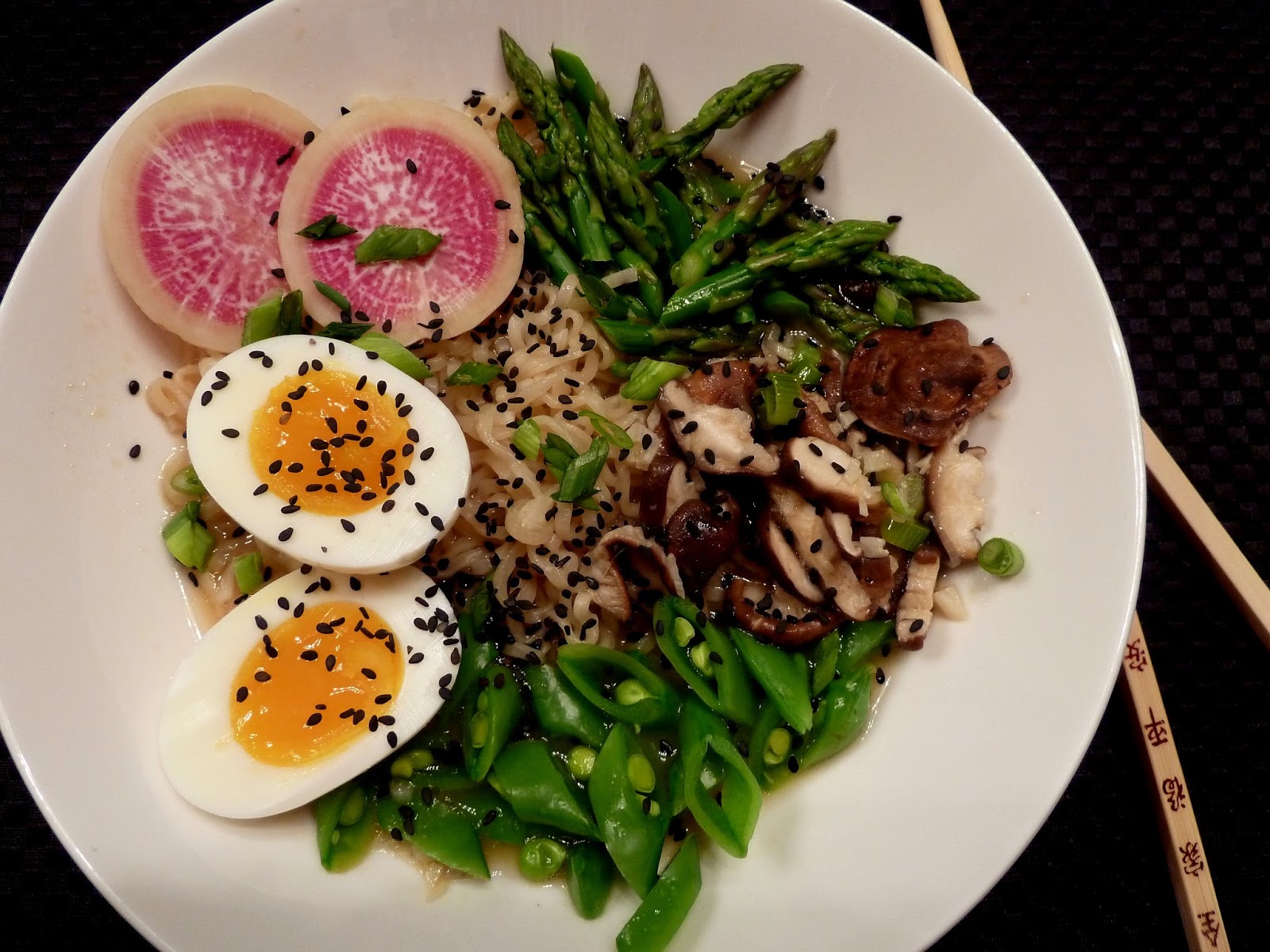
Spring Vegetable Ramen

Last Year's Post:  Chicken with Shallots
Two Years Ago:   Pan-Seared Tuna with Capers and Red Wine Sauce

If you're looking for a light, healthy entree to counter-balance a heavy food episode or just want to cut down a little, give this recipe a try.  The broth is warming and fragrant with garlic, ginger and sesame, and the miso adds a deep umami flavor.  (You can usually find white miso - the mildest variety, near tofu at well-stocked supermarkets.  If you can't find it, the broth will be good anyway.)  The vegetables add nutrition and crunch,and the egg is great protein.  You could always add or substitute some shredded chicken for the egg if you want a more substantial meal.

I love the black sesame seeds for drama, but toasted white sesame seeds would work just as well.  And I couldn't resist adding the watermelon radish simply because I found one at the grocery store.  They're not all that easy to find but very pretty.  Funny story:  I thought the radish would stump the cashier for sure, but she just kept right on going and never missed a beat.  When I told her I thought it was going to stump her, she said "I've been a cashier for 25 years so I don't get stumped easily".  The woman in back of me said she'd never heard of a watermelon radish and the cashier told her it was also known as a shallot.  Not quite!  Shallots are mild onions, watermelon radishes are radishes.  Oh
well.


I've been reading a fair amount about how to hard-boil eggs lately because I've had trouble with the shells sticking and ripping up the whites.  Turns out the best tip is to boil the water first, then gently lower in the eggs.  Cook 6 minutes for soft-boiled (runny yolk) or 8 minutes for hard-boiled (hard yolk), then immediately place in an ice bath to stop the cooking process.  Works really well - the shells don't stick at all.

Spring Vegetable Ramen
Serves 4

4 eggs
1 bunch slender asparagus, trimmed
6 ounces sugar snap peas, trimmed
2 tablespoons toasted sesame oil, divided
1 bunch green onions, sliced, white and green parts separated
4 cloves garlic, minced
1 tablespoon grated fresh ginger
2 cups water
2 cups chicken broth
3 tablespoons white miso
1 ½ tablespoons reduced-sodium soy sauce
4 ounces fresh shiitake mushrooms, stemmed and sliced
2 (3 ounce) packages ramen noodle soup, seasoning packets discarded
Black or white sesame seeds, for garnish (optional)
Sliced watermelon radish, for garnish (optional)

Hard-cook the eggs:  fill a saucepan with enough water to cover the eggs and bring to a boil, then gently lower the eggs into the water.  Reduce heat, cover, and let simmer for 8 minutes.  Remove the eggs and immediately place in a bowl filled with ice water to stop the cooking process.  When completely cool, remove and pat dry.  Shell the eggs and cut in half.

Cut the tips off the asparagus, then cut the spears into 1” lengths.  Bring a large pot of water to a boil and add the asparagus spears.  Let boil for 1 minute, then add the asparagus tips and the sugar snap peas.  Boil an additional 30 seconds, then remove all with a slotted spoon and place in an ice water bath (save the water and keep it hot).  When cool, remove the vegetables from the water and pat dry.  Slice the sugar snap peas diagonally into 3-4 pieces each.  Set aside.

In a large saucepan, heat 1 tablespoon oil over medium heat.  Add green onion whites, garlic and ginger and cook, stirring, until fragrant, about 1 minute.  Add water, chicken broth, miso, soy sauce and the remaining 1 tablespoon oil, bring to a rolling simmer.  Add the mushrooms and simmer for 3 to 5 minutes.

Meanwhile, place the ramen noodles in the boiling water left from cooking the vegetables.  Cook, stirring occasionally, for 3 minutes until soft.  Drain.

To serve, divide the ramen noodles between wide shallow bowls.  Ladle in the broth mixture and mushrooms, then top with asparagus and sugar snap peas.  Garnish each bowl with 2 eggs halves, sesame seeds and watermelon radish slices.  Top with green onion tops and serve.


Friday, March 22, 2013

Egg Gratin

Last year's post: Rustic Egg Tart

This recipe would be great for Easter or Mother's Day brunch. It's different from typical egg dishes - omelets, frittatas, scrambled eggs, stratas or souffles  - because it's made with hard-boiled eggs, peas and green onions that are baked in a delicious cheese sauce. It can be assembled in advance so all you have to do is bake it before serving, which makes it great for entertaining. It's also perfect for an easy but impressive dinner any night of the week.

I used to make a similar version fairly often while in college because it was cheap and good, cheap being the most important of the two virtues at the time. That version called for some sort of cream soup but I try to avoid canned soups now due to their additives and high sodium levels, plus it's easy to make the sauce from scratch.  Have you looked at the ingredient list on a can of soup lately?

fun at the grocery store
Let's talk about eggs for a minute. Eggs have a number of good qualities and one drawback. The drawback is that they're fairly high in cholesterol so you don't want to eat them every day, but in my opinion that's outweighed by the good qualities. Eggs are all-natural and packed with a number of nutrients. One egg has 13 essential vitamins and minerals in varying amounts, high-quality protein, unsaturated fats and antioxidants, all for 70 calories. Eggs' nutrients can help you with weight management, muscle strength, eye health, brain function and having a healthy pregnancy. Particularly important for aiding healthy brain function and pregnancy is choline (pronounced KOH-leen), which is amply present in eggs. (Can you tell I've been doing research on the egg council website?)  This recipe calls for six eggs and feeds 4-5 people, so you're only consuming a little more than one egg per serving.

Is this considered a vegetarian meal?  Not to get overly detailed, but most people who describe themselves as vegetarians are actually lacto-ovo vegetarians if they eat eggs and dairy products. "Flexitarians" is a new term that describes people who eat a mostly vegetarian diet but occasionally eat meat.  Vegans, on the other hand, do not eat meat of any kind and also do not eat eggs, dairy products, or processed foods containing those or other animal-derived ingredients such as gelatin.  Undoubtedly that was way more than you really wanted to know, but basically I consider this a vegetarian meal.  Unless, of course, you add a garnish of some crispy bacon.  Umm, bacon.  (If you have vegetarian friends it would probably be a good idea to ask if they eat eggs before serving this dish.)

You could substitute spinach for the peas in the recipe, but my old version had peas so I like them for sentimental reasons. You could also substitute cheddar or swiss cheese for the Gruyere, and use English muffins or French bread instead of Italian bread - just be sure whatever bread you use is toasted or grilled until crisp to provide textural contrast to the creamy eggs.

Obviously the garnish is optional but I thought it made the plate look more springtime-ish and the daikon sprouts add a fresh taste with just the barest hint of radish spiciness.  Or there's always bacon. (If you're feeling wild and crazy you could even fry up some chorizo.)

There's a world of opinions regarding how to hard-boil eggs, the two issues being how to avoid a green ring around the yolk and how to make sure the shell is easy to remove.  All I can tell you is that I cook eggs the way my mother taught me and I've never had green rings and very rarely have issues with the shells.  Here's how: place the eggs in a small saucepan and just barely cover them with tap water.

Bring to a boil uncovered, then turn the heat down and simmer, covered, for 15 minutes.  Stick the saucepan in the sink and run cold water on the eggs for a couple of minutes to cool them down and stop the cooking process.  Done.

If you're planning to serve this for guests I would encourage you to buy a gratin dish because it looks so pretty.  Basically they're shallow baking dishes, usually oval in shape.  This dish is approximately 7.5" by 12" (not counting the handles) and the recipe fit perfectly.  If you plan to double the recipe larger gratin dishes are readily available.  Of course any regular baking dish will work but won't have quite the same wow factor.


printable recipe

Egg Gratin
Serves 4-5

6 hard-boiled eggs
2 tablespoons butter
3 tablespoons all-purpose flour
1 ½ cups milk (whole or 2%)
1 teaspoon salt, divided
½ teaspoon pepper
¼ teaspoon ground nutmeg
1 ¼ cups shredded cheese (Gruyere, cheddar or swiss)
4 green onions, sliced
1 cup frozen peas (not thawed)
paprika
daikon sprouts (optional)
crumbled cooked bacon (optional)
grilled or toasted Italian bread, French bread, or English muffins

Preheat the oven to 450d.

Grease a 6-cup (1.5L) gratin or casserole dish.  Slice the eggs crosswise into 5-6 pieces each and arrange in the dish. 

Reserving a few green onions for garnish, sprinkle the remaining green onions and the peas over the eggs.

 In a medium saucepan, melt butter over medium heat.  Stir in flour and cook, stirring, for about 90 seconds, without browning.  Gradually whisk in milk, then add ½ teaspoon salt, the pepper, and nutmeg.  Continue whisking and bring to boil; reduce heat and simmer for 2 minutes.  Remove from heat; stir in 1 cup of the cheese until melted.  Taste for seasoning and add the additional salt if needed.

 Pour the sauce evenly over the eggs, peas and onions to cover all.  Sprinkle with the remaining cheese.  

Bake on the oven’s center rack until bubbly and very slightly browned, about 25 minutes.  Turn the oven to broil and allow the dish to brown to your liking while watching closely, approximately 30-60 seconds.

Remove and garnish with paprika and the remaining green onions.

 Serve over grilled or toasted bread, garnished with daikon sprouts and/or bacon (optional).