Showing posts with label white wine. Show all posts

Friday, May 8, 2015

Chicken with Shallots

Last Year's Post: Flax Seed Crackers
Two Years Ago:   Venetian Shrimp and Scallops

This recipe originated with Martha Stewart, then Andrew Zimmern's wife adapted it and he posted it on Twitter.  (If you're not familiar with Andrew Zimmern, he has a bizarre foods TV show where he eats a lot of bugs.)  Any way, his post was:  “Brown 8 thighs, 3 C shallots. Add wine, tarragon, Dijon, sim 30 min covered. Remove lid, reduce. Add 2C cut cherry toms.”   Succinct, but a little lacking in a few details.  The New York Times Cooking team picked it up and added a few more instructions, which is where I found it and adapted it slightly yet again.  It's kind of like starting a story to see if it bears any resemblance at all by the time it gets back to you.

Anyway, this is a very easy recipe to make because it only takes one pan and minimal prep.  Twelve to fifteen whole shallots may seem like a lot, but shallots have a delicate onion flavor to start and then they get caramelized which softens the flavor even more.  Wine, Dijon mustard and tarragon add richness and the relatively low and slow cooking time results in very tender chicken that's not dry.  I served it over wide pasta ribbons but it would be equally good with rice or bread to soak up the sauce.  Speaking of the sauce, I was surprised by how light it actually was.  For some reason I was expecting something like a cream sauce even though there's no cream (go figure) but it's much lighter than that.  This recipe reminds me somewhat of a French chicken dish that I previously posted called Chicken Gaston Gerard that has a Dijon sauce containing cream and cheese, so that might be where I got it.  This is a lighter version that that but it still tastes very French.


I eventually looked up the original Martha Stewart recipe just out of curiosity.  Her version had garlic, less wine, and more water in the sauce.  Next time I may add garlic but more wine is better in my opinion.  :-)

Chicken with Shallots
Serves 4

6 boneless skinless chicken thighs, rinsed and trimmed of excess fat
2 tablespoons flour
Salt and pepper
2 tablespoons unsalted butter
12 – 15 whole medium shallots, peeled
2 cups white wine
2 tablespoons Dijon mustard
2 sprigs fresh tarragon
2 cups cherry tomatoes, cut in half

Sprinkle the chicken thighs with flour, salt and pepper on both sides.  Melt the butter in a large skillet or pot over medium heat.  Add the chicken (in batches if necessary) and cook until browned on both sides (do not cook through).  Set aside.

Add the whole shallots to the same skillet and sauté until they begin to soften and caramelize, about 10-12 minutes.  Add the wine and deglaze with a large spoon, then add the mustard and tarragon.  Stir, then add the chicken thighs.  Cover, turn to low heat and simmer 30 minutes.

Remove the lid and allow the sauce to reduce and thicken for 15 to 20 minutes, adding the cherry tomatoes in the last 5-10 minutes so they begin to soften.


Serve immediately with rice, pasta, or bread to soak up the sauce.

Friday, May 3, 2013

Venetian Shrimp and Scallops

Last Year's Post: Chicken Salad with Fruits and Peppadews

This dish has a tomato-saffron sauce that is absolutely delicious with the tender scallops and shrimp.  (Be sure to serve it with lots of crusty bread for mopping up the sauce.)  It's very light, fresh and healthy with fragrant lemon zest and fresh basil, making it a perfect spring or summer seafood dinner. I can usually pretty well envision how a dish will taste just from reading the recipe, but I must say this one surprised me by just how insanely good it was the first time I made it.  It's become a regular repeater at our house, which only happens to the very best recipes since we like to try new ones so often.  If you like seafood you really should try it.

Saffron is a key ingredient in the flavor profile and the recipe won't be the same without it (ditto the lemon and fresh basil).  Crumble the saffron threads as you put them in the sauce for more flavor and more even distribution.  Someone gave me a teeny-tiny mortar and pestle for that very purpose several years ago.  I think it's hilarious because it's so small but I must admit it works great.  I've never seen them in any store and have no idea where it came from.  Don't you just love it?


I typically cut the scallops in half horizontally for this recipe, for a couple of reasons.  First of all, scallops should not be over-cooked or they get tough.  Since sea scallops are often really big, it's harder to be sure they're cooked all the way through without over-cooking them.  Cutting them in half results in a faster cook time, plus they're easier to eat and you have more of them in the dish.  I think five or six thinner scallops look much more attractive and plentiful (along with the shrimp) then two or three giant ones.  Searing them gives an attractive color, a nice caramelized crust, and additional flavor.


One thought about the diced tomatoes - I almost always use fire-roasted tomatoes because I think it adds a little more flavor and I like the little black flecks.  It's strictly a personal preference, but I would suggest checking the sodium content of whatever brand you choose because canned tomato products are notoriously high in sodium.  Same thing for the chicken broth.

This is a fast and easy meal to prepare so it's perfect for any night of the week, although I think it's certainly impressive enough to serve to company.


printable recipe
Venetian Shrimp and Scallops
Serves 4

¾ lb sea scallops, cut in half horizontally
¼ cup flour, seasoned with salt and pepper
1 tablespoon olive oil
2 tablespoons butter
2 garlic cloves, minced
1 large shallot, finely chopped
¼ teaspoon crushed red pepper flakes
1 cup dry white wine
1 cup low-sodium chicken broth
1 (14 oz) can diced tomatoes with juice
¼ teaspoon saffron threads, crumbled
¾ lb large shrimp, peeled and deveined
12 leaves fresh basil, shredded or torn
1 lemon, zested
Hot crusty bread

Lightly coat the sea scallops in the seasoned flour.  Preheat a large skillet over medium-high heat and add the olive oil and butter.  When the butter has melted, add the scallops and brown for 1 minute on each side.  Remove.

Add a little more olive oil to the pan if necessary, then add the garlic, shallots, and crushed red pepper flakes.  Reduce heat and sauté 2 minutes, stirring constantly.  Add wine to the pan and scrape up any pan drippings.  Reduce wine 1 minute, then add chicken broth, tomatoes with their juice, and crumbled saffron.  When liquids come to a bubble, add shrimp and cook 3 minutes.  Return scallops to the pan and cook everything together for 2 minutes longer.  Transfer shrimp, scallops and sauce to individual shallow bowls and top with basil and lemon zest.

Pass with bread for mopping up the juices.


Friday, February 1, 2013

Lobster with Pasta and White Wine-Butter Sauce

Last Year's Post: Tuxedo Strawberries

Time for a special dinner - Valentine's Day is coming up!  I think nothing is more romantic or special than an elegant and intimate dinner for two that you took the time and effort to prepare yourself.  And when I think about a special dinner, I usually think of lobster.  That good news is that although lobster is expensive in a nice restaurant, it's affordable when you prepare it at home.  You don't even need to buy really big lobster tails for this dish (although you certainly could if you wanted) because the lobster meat is combined with pasta and a delicious white wine-butter sauce.  A small-ish lobster tail per person is plenty (that's what I used in the picture above) and is often on sale at your local store around New Year's Eve and Valentine's Day for a very reasonable price.  I bought two 8-ounce tails for $8.99 each.  Including the rest of the ingredients, a loaf of french bread, and a very nice bottle of wine, I spent about $50 for this meal.  Think about what a bottle of wine and two lobster dinners would cost at a restaurant!

I've always liked the idea of lobster with pasta and spent many years searching for a great recipe.  I noticed that most lobster pasta recipes have either a heavy tomato sauce or a heavy cream sauce.  Either way, they tend to smother the lobster.  What's the point if you can't taste the lobster?    Plus, I love the taste of lobster and butter, so I knew I found the perfect recipe when I found this one and switched out olive oil for butter instead.  The sauce is light but very flavorful, and complements the lobster flavor rather than smothering it. The arugula adds a bit of color and flavor as well. The net result is truly a restaurant-quality dish.  As if that wasn't enough, it's really easy to make and isn't as messy as most lobster recipes because you simply take the raw meat out of the shell and saute it in the sauce.

Butter, wine, garlic, a little tomato puree, and lobster...yum yum
It's also easier to eat lobster this way rather than trying to get it out of a shell after it's cooked.  The Lawyer and I enjoy cooking together and we had fun preparing this meal, which is a great idea if you and your partner both like to cook.  (Not so great if you don't.)

Because the sauce isn't thick and heavy, it's important to add the cooked pasta to the sauce and toss it over the heat for a couple of minutes to allow the sauce to thoroughly coat the pasta and infuse it with flavor.  The entire meal only takes about a half hour to prepare.  Set a pretty table with some candles and flowers and you're all set!

click here for a printable recipe

Lobster with Pasta and White Wine-Butter Sauce
serves 2

2 small to medium lobster tails (7-10 ounces each), thawed
2 garlic cloves, minced
3 tablespoons butter
½ cup white wine
2 tablespoons tomato puree
½ teaspoon salt
¼ teaspoon pepper
6 ounces uncooked spaghetti (slightly less than half of a 1 lb package)
1 cup fresh arugula or baby spinach, coarsely chopped
1 tablespoon grated lemon peel
2 tablespoons fresh lemon juice

Using a sturdy scissors, cut down the middle of the lobster shells without cutting into the meat.  Pull the shells open and carefully remove the meat.  Cut into 1 inch pieces and set aside.

In a large skillet, melt the butter over medium-low heat.  Sauté the garlic in the butter for 1 minute, watching so the butter doesn’t brown.  Add the wine, tomato puree, salt and pepper.  Bring to a simmer over medium heat, then add the lobster and lower the heat to maintain a low simmer uncovered for 5-6 minutes or until the lobster is firm and opaque.

Meanwhile, cook pasta according to package directions.  Drain the pasta; add to the lobster mixture and toss to coat.  Stir in the arugula, lemon juice and peel; cook for 1-2 minutes or until the arugula is wilted.  Serve immediately.


Friday, December 28, 2012

Chorizo and Mushroom Fideua


Last year's post: Tiny Pizzas

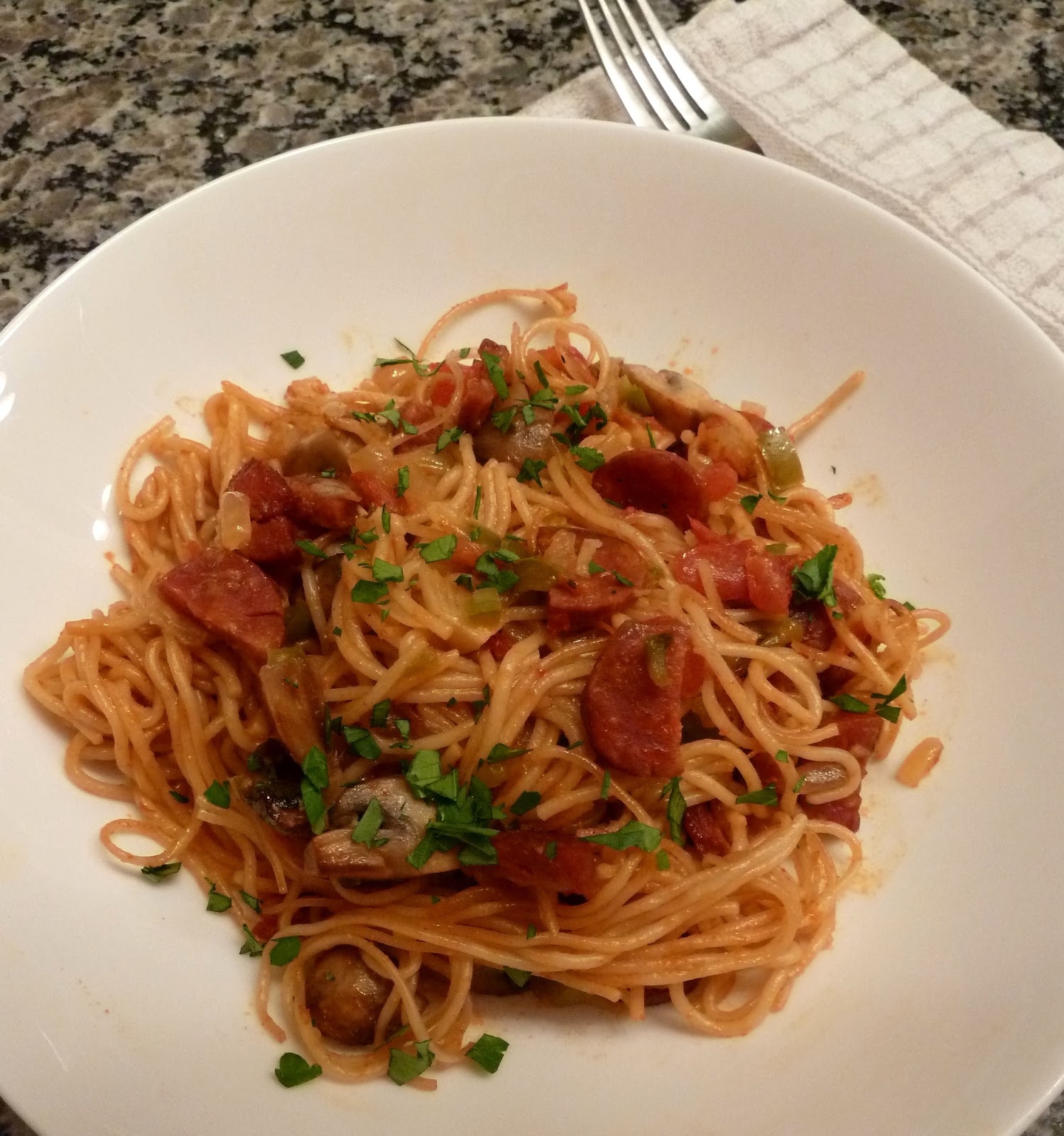
Fideua (FID-u-wah) is a pasta dish from Valencia, Spain that's somewhat similar to paella.  It typically contains seafood, paprika, tomatoes, onions, and peppers although this version contains Spanish chorizo and mushrooms in place of the seafood.  If you like paella and pasta, you'll like this dish.

It's very easy to make - you just keep throwing ingredients into a single pan and cooking until everything is done.  The pasta cooks in the broth mixture rather than separately, which infuses it with flavor.


By the end of the baking time all the liquid has been absorbed into the pasta but the dish is not at all dry.

 
A couple of thoughts about the ingredients - the recipe doesn't specify the type of paprika to use, so I use sweet paprika.  If you prefer, you could substitute half of the sweet with either half-sharp or smoked paprika.  And about chorizo - I've mentioned it before but it bears repeating, Spanish chorizo is not the same as Mexican chorizo.  Spanish chorizo is a dry, cured meat that looks a lot like pepperoni.


You can find it in most markets these days.  It comes in regular and hot (caliente) versions.  We prefer the hot (it's not really all that hot) which is why I use regular paprika instead of half-sharp.  It has a paper covering that needs to be removed before slicing.  I mention that specifically because the paper is pretty much the same color as the chorizo so it's not all that obvious until you start slicing, at which point it's a bigger hassle to remove from each little piece.

One last thought - I'm still slightly nervous about any recipe which you first cook on the stovetop, then put the pan in the oven to finish cooking ever since I took a skillet out of a 450d oven, turned away to do something else, then turned back and automatically grabbed the metal handle with my bare hand.  One quick trip to the emergency room later I had a rather spectacular bandage covering four fingers and my palm.  (The Lawyer drove me to the hospital because I was pretty convinced my hand was going to need some sort of dramatic procedure. Turns out it was just antiseptic ointment and lots of bandages.) Be sure to keep those oven mitts on!

* * click here for a printable recipe version * *

Chorizo and Mushroom Fideua
Serves 4 to 6

Note: because the angel hair pasta is cooked in the pan rather than boiled in water, it takes longer than stated on the package.


2 tablespoons olive oil
1 medium onion, chopped
2 large garlic cloves, minced
½ lb mushrooms, quartered
2 teaspoons paprika
Pinch of cayenne pepper
2 medium tomatoes, peeled, seeded and chopped
1 large green bell pepper, diced
3 cups low-salt chicken broth
½ cup dry white wine
5 ounces Spanish chorizo, paper casing removed
¾ lb angel hair pasta
Minced fresh parsley


Preheat the oven to 400d. Cut the Spanish chorizo lengthwise, then crosswise into half-moon slices. Heat the olive oil in a heavy deep paella pan or oven-proof sauté pan over medium heat. Add the onions and garlic and cook until tender, stirring frequently, about 5 minutes. Add mushrooms and sauté 4 minutes. Add paprika and cayenne and stir just until fragrant, about 30 seconds. Add tomatoes and green peppers and sauté 2 minutes. Add chicken broth, wine and chorizo. Bring mixture to a simmer. Break pasta in half and add to pan. Cook until pasta is tender, stirring occasionally, about 7 minutes. Set pan in oven and bake until all liquid is absorbed and pasta is crusty, about 25 minutes. Sprinkle with parsley.


Friday, September 21, 2012

Pork with Fennel and Caper Sauce


Capers vs Caperberries

We were at a restaurant with friends a while ago and two of the dishes had these green things with long stems that looked like olives but didn't have a pit and tasted like the best olive you ever had.  The chef happened to walk by so my friend Terry asked him what they were.  He replied that they were capers. Well, we know capers and this definitely was much bigger than a caper - more the size of a green olive.  He said they were capers that were left on the bush for a longer time.  I'd seen these things on the olive bar at Whole Foods and they were called caperberries but I had never actually tried them before.

That was enough to get my curiosity going so I researched caperberries when I got home.  Turns out that capers and caperberries come from the same bush but capers are the immature flower buds and caperberries are the fruit (so even the chef didn't actually know!).  Both are usually consumed pickled.  Both have a similar tart, salty burst of flavor although caperberries are more mild.  I found both in the pickle section of my grocery store right next to each other.


If you're curious about the difference, this recipe features them both.  They work ideally in Mediterranean-type recipes with tomatoes and vegetables.  The capers are part of the sauce, and the caperberries are more of a garnish (in my opinion) although they could easily substitute for green olives in any recipe.

If you're not all that curious about caperberries, just leave them out but keep the capers for the sauce - the tartness is an important component of the overall flavor profile with the tomatoes and fennel.  If you're not familiar with fennel, it's a crunchy vegetable with a slight anise flavor that's delicious raw in salads.  I like it equally well when it's sauted  - it becomes very mild and tender.  The important final component of the sauce is the bright note of lemon zest (LOVE lemon). 

I adapted this recipe to use pork tenderloin because it's a favorite of ours, but it would work equally well with pork chops or even a meaty swordfish or tuna steak.  We served it with mashed potatoes but rice or creamy polenta would be great also.  The meal was warm and earthy but light, a perfect fall dinner.

* * click here for a printable recipe * *

Pork with Fennel and Caper Sauce
Serves 4

¼ cup olive oil
1 (1.25 lb) pork tenderloin
¾ teaspoon salt, plus more for seasoning meat
¾ teaspoon black pepper, plus more for seasoning meat
1 large or 2 small fennel bulbs with fronds, cut in half, cored and thin sliced (about 2 cups)
2 large shallots, thin sliced
2/3 cup chopped fresh flat-leaf parsley, divided
½ cup white wine
1 (28 oz) can diced tomatoes with their juices
½ lemon, zested
2 tablespoons capers
Caperberries for garnish, optional


In a large, heavy skillet heat the olive oil over high heat. Season the pork tenderloin with salt and pepper. Add the pork to the pan and brown on top and bottom, about 4 minutes per side. Remove the pork from the pan, cover loosely with foil and set aside.

Add the fennel, shallots, and 1/3 cup parsley to the pan and cook over medium heat until beginning to brown, about 5 minutes. Add the wine. Scrape the brown bits off the bottom of the pan, then add the tomatoes and stir. Add the pork back into the pan between the fennel and tomatoes so it’s mostly submerged in the pan juices. Cover and cook until the fennel is tender and the pork is done, about 12 to 15 minutes.


Place the pork on a cutting board. To finish the sauce, add the lemon zest, remaining 1/3 cup parsley, capers, and ¾ teaspoon each salt and pepper. Stir to combine.

Slice the pork into ½” thick slices and serve with the sauce. Garnish with optional caperberries.