Saturday, February 27, 2016

Roasted Carrots with Herbs

Last Year's Post: Baked Pumpkin Spice Granola
Two Years Ago:  Power Muffins

I think carrots are one of the most taken-for-granted vegetables you can find, and I would have included myself in that camp until recently.  I mean, raw carrots are everywhere, particularly those little cut-up mini carrots that show up in everyone's lunches.  And cooked carrots?  Meh.  My memories of cooked carrots include chunks of carrot cooked to death with potatoes and pot roast until everything tastes like carrots.  Or even worse, chunks of carrots that are boiled or steamed until mushy, then tossed with some heavy sweet and sticky sauce (the better to cover up the taste, probably).


And then I discovered the wonders of roasting vegetables, and particularly carrots.  As they roast the sugars are caramelized and intensified, so the result is a fork-tender and sweet vegetable without the cloying sweet sauce.  They're not only pretty, but truly delicious and of course very good for you.  I've come across a couple of roasted carrot recipes lately that add large amount of butter and one that even adds Brie cheese if you can imagine, but I think simpler is better - a little olive oil, salt, and fresh herbs.

Rainbow-colored carrots are the prettiest and they're becoming easier to find - I've seen them at upscale grocers, natural food stores and farmers markets.  Smaller carrots are more cute because you can leave them whole, but this technique works equally well for larger carrots that are cut up.


One of the biggest benefits to roasted carrots is that they taste equally good hot or at room temperature, so they're perfect for a buffet (think about a big platter of carrots next to your ham and scalloped potatoes at Easter).  They're also great as a side dish next to roast beef, chicken, pork or lamb - just throw them in the oven as the meat rests and gets carved.

Or, as we had them today, they're a great centerpiece for a vegetarian meal with winter greens, a few pieces of good cheese and some toasted nuts.  We had somewhat over-indulged at a weekend breakfast so this was the perfect balance for dinner.


print
Roasted Carrots with Herbs
Serves 4-6

2 lbs carrots (small to medium size is preferable)
2 tablespoons extra-virgin olive oil
1 tsp coarse salt
2 tablespoons chopped fresh herbs, such as chives, thyme, parsley, or a mix


Wash and peel the carrots, leaving about ½” of green tops.  If small, leave whole, and if larger cut in half lengthwise and crosswise.

Heat oven to 450d.

In a large bowl, toss the carrots with oil, salt and half the herbs.  Spread in a single layer on a parchment-lined baking sheet.  Roast, shaking the pan once, about 25 minutes until the carrots are fork-tender.  Turn the oven to broil for a minute or two to brown the tops, watching closely so the carrots don’t burn.  Remove and sprinkle with the remaining herbs. 

Serve hot or at room temperature.

Friday, February 19, 2016

Chicken with Lemon Pomegranate Sauce and Pistachio Rice

Last Year's Post:  Spinach, Squash and Apple Salad

I've had pomegranates before, as well as pomegranate juice, but not pomegranate sauce.  When I encountered this recipe, I thought the sauce would be bright red, relatively thick and sweet-tart, much like pomegranate seeds.  The reality, however, is something quite different - the recipe uses pomegranate molasses (a new ingredient for me) and lemon juice without any sugar at all to create a very bright, puckery sauce that's more like a vinaigrette.  I was a little concerned that it might need a touch of honey when I tasted it on it's own, but it was perfect when paired with the chicken - a very bright and interesting balance of flavors.

Who doesn't need another chicken recipe?  This one is healthy but also somewhat exotic with Middle Eastern flavors of pomegranate, cardamom, pistachios and dried fruits to get you out of your chicken rut.  And it's very fast to make - around 30 minutes all told - so it works for a weekday meal.

You can find pomegranate molasses in some upscale grocers (I found mine at Whole Foods), natural food stores, and of course Middle Eastern markets.


The sauce would also make a be great with pork or shrimp, and I can even see it as a salad dressing (it might need a touch of honey as a dressing but that's up to you).


Chicken with Pomegranate Lemon Sauce and Pistachio Rice
Serves 4

For the Sauce:
3 tablespoons pomegranate molasses
½ teaspoon lemon zest
3 tablespoons fresh lemon juice
3 tablespoons olive oil
¼ teaspoon salt
¼ teaspoon black pepper

For the Chicken:
2 large chicken breasts or 4 chicken cutlets
Salt and pepper
1 tablespoon olive oil

For the Rice:
½ cup finely chopped onion
½ teaspoon turmeric
¼ teaspoon ground cardamom
1 tablespoon unsalted butter
2/3 cup long-grain white rice
1 1/3 cups chicken broth
4 tablespoons pistachios nuts, toasted lightly and chopped
4 tablespoons golden raisins, currants, dried cranberries (or a combination)
4 tablespoons thinly sliced green onions
Salt and pepper


To make the sauce, whisk all ingredients together in a bowl to combine; set aside.

Next start the rice:  in a small heavy saucepan cook the onion with the turmeric and cardamom in the butter over moderately low heat, stirring, until the onion is softened.  Add the rice and cook, stirring, until coated with butter.  Add the broth, bring the liquid to a boil, cover, then reduce heat and simmer for 20 minutes until the liquid is absorbed.  Stir in the pistachios, dried fruit, green onions, and salt and pepper to taste.

While the rice is cooking, cook the chicken: cut the chicken breasts in half horizontally to form four cutlets (skip this step if you already have cutlets).  Salt and pepper both sides.  Heat the olive oil in a large skillet over medium-high heat, then add the chicken and sauté for 2-3 minutes per side until golden brown and cooked through.


To serve, divide the rice between plates and top each with a chicken cutlet.  Spoon the sauce over the chicken and serve.

Friday, February 12, 2016

Pasta Arrabiata

Last Year's Post: Coconut-Marinated Pork Tenderloin with Pineapple Rice
Two Years Ago:  Sesame Seed Chicken Salad

Arrabbiata is a spicy sauce for pasta made from garlic, tomatoes, and red chili peppers cooked in olive oil.   The word "arrabbiata" literally means angry in Italian, which supposedly is a reference to the spiciness of the sauce.  If that's true, this recipe is more grumpy than angry - it's mildly to moderately spicy depending on how much crushed red pepper you add.  Additional depth of flavor comes from the paprika and optional pepperoncini without adding a lot of heat.  I just happened to have a jar of pepperoncini in my refrigerator (no idea why) so I added some, but didn't notice it in the finished dish so I listed it as optional.  I don't think it's worth buying an entire jar just for this recipe.

In addition to being spicy, Arrabbiata recipes often include black olives and capers to give it additional flavor and texture.  I particularly like the salty pop of the capers.


Because the sauce is relatively light, it's important to throw the cooked pasta into the pan with the sauce and toss it around for a couple of minutes.  This allows the sauce to evenly coat all of the pasta and infuse it with flavor.  I've heard Lidia Bastianich, one of the foremost Italian cooks in America, state that this step is so important that she wouldn't finish pasta any other way. I've discovered there's only one caution to this approach - add the cooked pasta to the sauce gradually unless you're very sure of your pasta-to-sauce ratio.  If you dump it all in at once and decide it was too much pasta for the amount of sauce, you're up the proverbial creek without a paddle.


This is a simple, fast healthy and light pasta dish that won't weigh you down but is perfect comfort food on a cold night.  And, it even qualifies for meatless Mondays.

print
Pasta Arrabbiata
Serves 4

3 tablespoons extra-virgin olive oil
1 small onion, minced
2 garlic cloves, minced
1/2 cup pitted black olives, coarsely chopped
2 tablespoons drained capers, rinsed
1/2 teaspoon sea salt, plus more to taste
¼ - ½ teaspoon dried crushed red pepper flakes, depending on your preference
½ teaspoon paprika
2 teaspoons anchovy paste
2 tablespoons stemmed, seeded and minced pepperoncini (optional)
1 28-ounce can crushed Italian tomatoes
1 pound hot cooked pasta
Grated Parmesan Reggiano


In a large skillet over medium heat, heat the oil.  Add the onion and garlic and sauté for 3 minutes. Reduce the heat to medium and add the olives, capers, 1/2 teaspoon of salt, red pepper flakes, paprika, anchovy paste and pepperoncini and sauté for 1 minute. Add the tomatoes and simmer until reduced slightly, about 20 minutes. Add 1-2 tablespoons of grated Parmesan to the sauce and stir to combine. Taste and adjust seasonings.   

Friday, February 5, 2016

Vietnamese Shrimp Baguette

 Last Year's Post: Sea Bass in Papillote
Two Years Ago:   Raspberry Dark Chocolate Wonton Cups

If you like Vietnamese food you're sure to love this sandwich.  Similar to a Banh Mi (the famous pork-based Vietnamese sandwich - recipe here) this sandwich is served on a crisp and light baguette and includes several vegetables for crunch.  However, instead of meat in an Asian-type barbecue sauce, this sandwich has shrimp sauteed in an immensely flavorful and moderately spicy puree made from lemongrass, garlic, vinegar, serrano pepper, ginger and cilantro.  The result is lighter but punchier than the pork version, if that makes any sense.

Ever wondered how chefs make those beautiful carrots strips?  You can buy a peeler at Bed, Bath and Beyond (and I'm sure elsewhere) with serrated edges.  All you do is run it down the carrot for perfect strips every time.


And here's another interesting thing I learned along the way - the sushi chef at my local grocer informed me that the pink pickled ginger you can buy in jars is "the cheap stuff" and that sushi chefs use white pickled ginger (shown below on the upper left).  He sold me a small container of his secret stash.  Ask the next sushi chef you run across if you're interested, or you can find white pickled ginger in jars at some natural foods stores.


I find myself on the slippery slope of spiciness again.  Just how spicy is "moderately spicy"?  Enough so you notice some heat, but not enough to make your lips burn. And not enough to cover up the other flavors in the sandwich.  The original recipe that I adapted called for a bird's eye chile, which I couldn't find so I decided to substitute a serrano chile instead. Then I did a little research to figure out how they compare in heat.  I found this very handy chart that lists the heat level of pretty much every pepper you can think of, and was surprised to find that bird's eye chiles are quite a bit hotter than a serrano.  I think I'm glad I didn't find the bird's eye chile.


The sauce on the shrimp has bold flavors but the carrots, radishes, pickled ginger and cilantro all add flavor complexity and crunch as well.  The mayonnaise tones things down and adds creaminess, and of course there's that great crisp baguette.  All in all, I would call this one of the great sandwiches right up there with the Banh Mi.


printable recipe
Vietnamese Shrimp Baguettes
Makes 2 sandwiches
  
8 ounces peeled and deveined raw shrimp, tail shells removed
10 cilantro stems, divided
2 cloves garlic
1 serrano chile, stem cut off
2-3” lemongrass stalk
5-6 thin slices fresh ginger
1 teaspoon fish sauce
2 teaspoons rice vinegar
2 teaspoons olive oil
½ carrot, cut into thin matchsticks
2 tablespoons pickled ginger, chopped
1 green onion, thinly sliced
4 radishes, thinly sliced
2 tablespoons mayonnaise
2 small baguettes


Chop the shrimp and set aside.

In a small food processor, combine 8 stems of cilantro, the garlic, chile with seeds, lemongrass, fresh ginger, fish sauce and rice vinegar and puree.  Toss the puree with the chopped shrimp.

Heat a nonstick frying pan over medium-high and add the oil, then add the shrimp mixture and cook, turning several times, for about 4 minutes or until lightly browned and cooked through.

Split the baguettes and spread with mayonnaise.  Stuff with the shrimp and top with carrot, pickled ginger, green onion, radishes, and the leaves of the remaining 2 cilantro stems.


Friday, January 29, 2016

Prosciutto-Wrapped Chicken with Asparagus Pesto Sauce

Last Year's Post: Hand Blended Loose Leaf Chai Tea
Two Years Ago:  Coq au Vin

Life as a food blogger has its ups and downs.  The downside happens when a recipe doesn't come out as you hoped, or it was a ton of work, or it tastes good but doesn't look like much.  But then there's the upside when a recipe is even more delicious than you thought, it's easy to make and beautiful to boot.  Happily, this is one of those because I had a spectacular (and expensive) halibut failure last week and was feeling rather traumatized but now I'm all better.  :-)

It's so spectacular, in fact, that I would suggest it for a special occasion dinner like a birthday, anniversary or Valentine's day - it's that good.  And it's fast enough to make on a weeknight - all you have to do it steam some asparagus, cook some pasta or rice to go with the dish, then cook the chicken and add the sauce at the end.  I was tempted to leave out the cream but after tasting it I wouldn't - it adds flavor and creaminess (duh) and it's only a 1/4 cup for four servings.

The recipe was so easy that I couldn't even think of all that many pictures to take of the process.


Prosciutto-Wrapped Chicken with Asparagus Pesto Sauce
Serves 4

6-8 ounces asparagus, tough ends snapped off, cut into 1” pieces
¼ cup flour
4 chicken cutlets (or 2 large chicken breasts, cut in half horizontally to make 4 cutlets)
4 slices prosciutto
2 tablespoons extra-virgin olive oil
¼ cup pesto
¼ cup heavy cream
¼ cup chicken broth
Fresh basil leaves, for garnish (optional)
Hot cooked pasta, rice or mashed potatoes for serving


Steam the asparagus pieces for 4-5 minutes (depending on the size of the spears this may need to be adjusted up or down) until crisp-tender, then run under cold water or shock in an ice bath to stop cooking.  Drain and set aside.

Put the flour in a shallow plate.  Pat the chicken cutlets dry, then season with pepper on both sides.  Lightly dredge both sides in flour and shake off the excess.  Wrap a piece of prosciutto around each cutlet and set aside.

Mix the pesto, cream and chicken broth together in a small bowl.  Set aside.

When ready to start cooking, heat the olive oil in a large heavy skillet over medium-high heat.  Add the chicken cutlets and cook for five minutes or until the cutlets release easily without sticking and are golden brown.  Lower the heat to medium, turn the cutlets over and cook for an additional 4-5 minutes until golden and cooked through.

Lower the heat to low and add the pesto sauce.  Simmer very gently for 1-2 minutes until the sauce thickens slightly, then add the asparagus.  Simmer for another minute to heat the asparagus through, then taste and adjust seasonings (remember the prosciutto is salty so go easy on salt in the sauce).


Place the cutlets with the asparagus pesto sauce over hot pasta, rice or potatoes.  Garnish with optional basil leaves and serve immediately.

Saturday, January 23, 2016

Sesame Salmon en Papillote

Last Year's Post:  Eggplant and Rice Parmigiana
Two Years Ago:   Lobster and Shrimp Gratin

Cooking something "en papillote" (pronounced en pa-pee-oh) is French for cooking "in parchment" - basically cooking in a paper pouch to seal in moisture.  It's a great way to cook delicate fish because it seals in the moisture so the fish doesn't dry out, and at the same time it becomes infused with the flavors of the sauce.  I've previously posted recipes for swordfish en papillote (with an Italian twist) and sea bass en papillote (with a Mediterranean theme) so I thought this Asian salmon would be a good complement.   
It's not only flavorful, it's a very healthy dinner as well.  I modified a recipe that I found online to include spinach for nutrition and color, mushrooms for flavor, and sesame seeds for crunch and because they look great.  A mix of white and black seeds is especially attractive - you can find black sesame seeds at Asian markets and at Penzeys - but all white seeds would work also.  Tip: you can usually find a large container of toasted white sesame seeds in the Asian section of your grocery store for much less than a small bottle in the spice aisle.

The recipe is really easy once you get the parchment paper technique down.  Basically you just take a big piece of paper, fold it in half, and cut it in a folded semi-circle with one end slightly more pointy than the other.  Open it up, pile the ingredients on one side of the fold, and close the other side over the top.  Then you start make tight little overlapping folds to ensure the packet is sealed.  Or, you could just use aluminum foil and crimp the edges which is easier, but not as traditional or pretty.  If you plan to serve the packets at the table, parchment is definitely the way to go.


Sometime I remove the contents from the packets before serving, depending on my mood and the contents of the packet.  If there's going to be a lot of cutting involved it tends to be easier to take them out of the paper although it's less dramatic and fun.   Either way, it's a fast, easy and delicious meal that's very healthy.


print
Sesame Salmon en Papillote
Serves 4

For the sauce:
Zest of ½ orange
1 tablespoon fresh orange juice
1 teaspoon peeled minced fresh ginger
3 tablespoons soy sauce
2 teaspoons rice vinegar
2 teaspoons toasted sesame oil
1 teaspoon honey

10-12 leaves baby spinach per packet, about ½ bag of baby spinach
1 red bell pepper, seeded and thinly sliced
7 ounces shiitake mushrooms, cleaned, stemmed and thinly sliced
4 (6 ounce) salmon fillets, skinned
Freshly ground black pepper
¼ cup toasted white or black sesame seeds, or a mix
1/3 cup green onions, thinly sliced on the diagonal
Parchment paper (or aluminum foil)

Preheat oven to 425d.

Combine all sauce ingredients in a small bowl and whisk until blended; set aside.

Cut 4 large (approximately 16” by 12”) sheets of parchment paper.  (If you don’t have parchment paper, foil works just as well but definitely transfer the contents out of the foil before serving.) Fold each sheet in half. Place the fold on the bottom edge nearest you. Starting at the right side, cut a large semi-circle with the fold as the spine and one end more pointed then the other.  Open the paper and place ¼ of the spinach leaves, red bell pepper and shiitake mushrooms in a pile on one side, near the fold.  Moisten with one tablespoon of the sauce.  Place a salmon fillet on top; season with black pepper and additional tablespoon of marinade.  Sprinkle the top of the salmon with sesame seeds.

Fold the other half of the paper over the fish. Starting at the flatter end of the semicircle (not the pointy end), fold 1-2 inches of the edge inwards. Work your way around the circle making a series of tight, overlapping folds to enclose the fish. When you reach the pointy edge, fold the last pleat several times and wrap it under the pouch.  Repeat with the other three packets.

Place the packets on a baking sheet and bake for 11-12 minutes, depending on thickness.


Transfer the packets to plates and cut open.  Garnish with green onions prior to serving.  Alternatively, transfer the package contents to a plate and garnish prior to serving.  Serve any remaining sauce on the side.

Friday, January 15, 2016

Shrimp and Bacon Ramen

Last Year's Post:  Chicken Pho
Two Years Ago:   Italian Sausage Soup

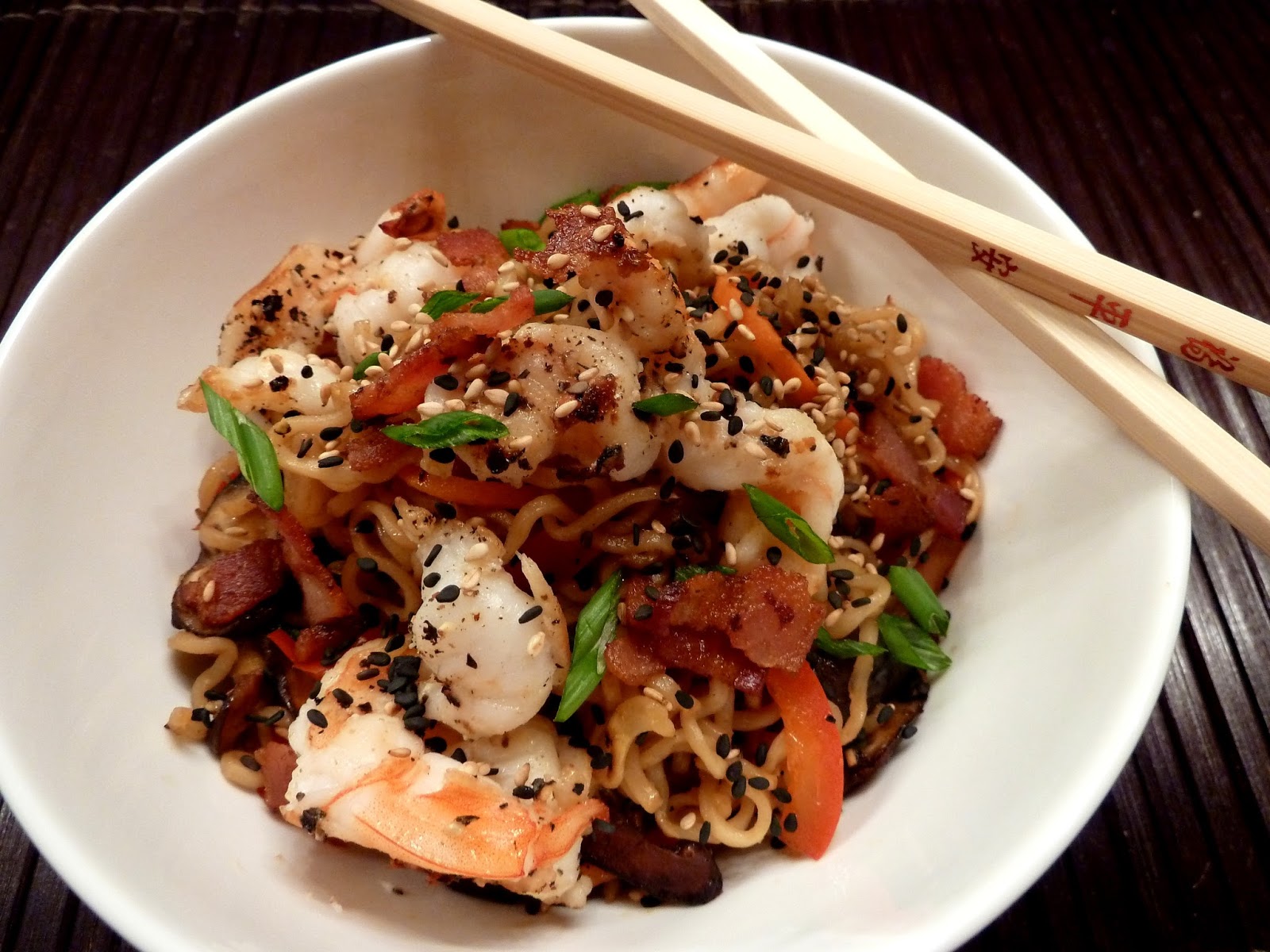
I love ramen noodles because I love all things pasta, but ramen has the additional benefit of all those fun curls.  Plus, it's cheap, easy to cook, and a perfect blank canvas for nearly any sauce and ingredients.  This particular recipe is sort of an American-Asian mashup of ingredients much like you'd find at a good food truck - good old American bacon pairs up with the typical Asian flavors of soy sauce, sesame oil, shiitake mushrooms, red bell pepper and shrimp for an absolutely delicious result.  Of course, if you want to make it a little lighter you could leave out the bacon but it really added that little extra something.  I adapted it from a recipe that called for a lot of special Asian ingredients and substituted readily-available ingredients instead.

I love my serrated grater for making the thinnest carrot strips, but if you don't have one (hint:  Bed, Bath and Beyond) just cut them as thin as you can.  The benefit to having long thin strips is that after they're briefly sauteed they soften a little and start to mimic the noodles in shape and twirl-ability.


Start by doing all your prep, of course, including the shrimp - peel and devein them, take off the tail shells, then cut them through the back all the way down to (but not through) the tail to butterfly them open.  That does two things:  it allows them to cook faster and more evenly, plus they curl into the coolest shapes as they cook.  Very fancy.


When everything is ready, cook the bacon while you're cooking the ramen noodles.  Use half the bacon fat to cook the shrimp and vegetables, then use the other half to briefly fry the noodles to make them a little crispy.  Toss everything with the sauce until it's absorbed, and you're done - very fast and easy.  And again, if you don't want to include the bacon, just use a little peanut oil instead.  You could also skip the step of frying the noodles to cut down on fat and calories - the noodles will just be a little softer.


I would put this up against your favorite food truck food any day, plus you get to eat it piping hot at home whenever you want.


print recipe
Shrimp and Bacon Ramen
Serves 4

For the sauce:
1/3 cup soy sauce
1 tablespoon rice wine vinegar
1 ½ teaspoons toasted sesame oil

For the ramen:
4 (3 ounce) packages ramen noodles
1 teaspoon toasted sesame oil
4 strips of bacon, cut crosswise into 1/2-inch pieces
12-14 ounces large shrimp (about 4 per person), peeled and deveined, tails removed
4 green onions, thinly sliced
1 red bell pepper, thinly sliced
1 carrot, peeled and cut into matchsticks (or julienned)
1 tablespoon peanut or olive oil
6 ounces shiitake mushrooms, cleaned, stems removed, and sliced
Toasted sesame seeds for garnish, optional


For the sauce, whisk all ingredients together in a small bowl and set aside.

Cut each shrimp in half lengthwise almost to the tail end (but not cut in half completely). 

For the noodles:  bring a large pot of salted water to a boil.  Cook the noodles until just barely cooked according to package directions (they will cook more later).  Drain and rinse with cold water.  Using a kitchen shears, cut the noodles into approximately 8-inch lengths.  Toss with 1 teaspoon sesame oil to prevent sticking. Set aside.

Cook the bacon in a large skillet over medium heat until crisp and brown, then transfer to a paper towel-lined plate.  Remove and reserve half of the bacon drippings in a small bowl for later.  Re-heat the remaining bacon drippings over medium heat, then add the shrimp to the pan and sprinkle with salt and pepper.  Sauté, turning occasionally, until the shrimp are curled and cooked through, about 4 minutes.  Remove to a plate.

Add a tablespoon of oil to the same pan and place over medium heat.  Add the mushrooms and sauté for 2-3 minutes, stirring occasionally.  Add the red pepper and carrots and sauté for additional minute or two, then add the green onions and sauté for 30 seconds.  Remove to a large bowl.

Add the remaining bacon fat to the pan and heat to medium-high.  Add the noodles and cook, stirring minimally, until the noodles are crispy and charred in places, about 3 minutes.

Add the noodles to the bowl with the mushrooms, green onions, red pepper, and carrots.  Add the sauce and toss again.  Divide among bowls, then top with shrimp and bacon.  Garnish with sesame seeds, optional.