Showing posts with label bar food. Show all posts

Friday, June 10, 2016

Slow Cooker Buffalo Chicken Sliders

Last Year's Post: Mini Shrimp Tacos
Two Years Ago:  Grilled Lobster Cobb Salad


I really like the idea of cooking buffalo chicken sliders in a slow cooker, because you can make a double batch for a party with very little work (and without heating up your house if it's summer).  For some reason buffalo chicken sliders seem like party food to me, how about you?  They would be perfect for a summer party outdoors with some cold beer, for example.  You could serve them along side some little burger sliders for the beef eaters and everyone would be happy.

Several of the recipes I found called for ranch dressing and blue cheese crumbles, which I thought was interesting enough that I included it here.  The result has a slightly lighter taste overall (which I liked) than if you use straight blue cheese dressing, but it's totally up to you either way.

The recipe is incredibly easy - just season some boneless skinless chicken thighs and throw them in the slow cooker with some hot sauce.  When they're done, they are so tender that you can just shred them right in the pot.


Assemble the sliders and offer pickle and jalapeno slices on the side for those who are so inclined.  Be sure to have plenty of napkins on hand - these little babies are messy unless you shove the entire slider in your mouth all at once, which would be interesting to watch.


One last note:  the exact number of sliders you can make depends on the size of your rolls and how high you pile them.  My rolls were about 3" across and I didn't go too wild piling on the chicken, which is how I arrived at the calculation of 12 sliders.

print recipe
Slow Cooker Buffalo Chicken Sliders
Makes approximately 12 sliders depending on the size of the buns

1 ½ pounds boneless skinless chicken thighs
Kosher salt and freshly ground black pepper
1 teaspoon paprika
1/8 teaspoon cayenne
1 ¼ cups hot sauce, such as Frank’s Red Hot
12 small slider rolls
Ranch dressing and blue cheese crumbles (or blue cheese dressing)
Tomato slices (from 3-4 small tomatoes)
Green leaf lettuce
Pickle slices, optional
Jalapeno slices, optional


Sprinkle the chicken with salt, pepper, paprika and cayenne and place in a slow cooker.  Pour in the hot sauce.  Cover and cook on low for 8 hours or high for 4 hours.

Shred the chicken with two forks right in the slow cooker.

Brush the cut side of the buns with olive oil and place under a broiler for a few seconds until browned, watching closely so they don’t burn.


To assemble the sandwiches, place a piece of lettuce on the bottom half of each bun, followed by a tomato slice and some shredded chicken.  Top with ranch dressing and blue cheese crumbles.  Serve with pickles and jalapeno slices on the side for those who want to add them.

Friday, October 23, 2015

Chicken Schnitzel Sandwiches

Last Year's Post: Korean Sliders
Two Years Ago:  Tomato Soup and Grilled Cheese - All Grown Up

It's fall, and it's football season, which also makes it beer season.  I thought I'd get in the spirit of things by posting a very beer-friendly sandwich that's a twist on the classic veal or pork schnitzel - a chicken schnitzel sandwich with cider-braised red cabbage, Swiss cheese, and a combination of whole-grain mustard and mayo.  I even went all-out with pretzel rolls, but you could use hamburger buns or mini-baguettes if you can't find them.   Serve with your favorite craft beer and some chips or onion rings, and you've got the perfect pub meal.


You could certainly use veal or thinly-pounded pork in place of the chicken, but chicken cutlets are the perfect thinness without any pounding and are readily available in the grocery store.  If you can't find them, just cut chicken breasts in half horizontally.

The panko crumbs give the cutlets the perfect crunch to go with the tender braised cabbage.  The mustard-mayo sauce is creamy and full of flavor, but if you want to amp things up a bit you could add a little hot mustard powder or horseradish to the sauce as well.  Either way, this is a fun addition to your sandwich collection.


 print recipe
Chicken Schnitzel Sandwiches
Serves 4

For the braised cabbage:
½ head red cabbage, thinly sliced
2 tablespoons butter
2 teaspoons caraway seeds
½ cup apple cider
½ cup cider vinegar
Salt and pepper

For the chicken:
4 chicken cutlets (or 2 chicken breasts sliced in half horizontally)
Salt and pepper
½ cup flour
2 eggs, beaten
1 cup panko bread crumbs
2 tablespoons vegetable or peanut oil

For the sandwiches:
½ cup mayonnaise
½ cup whole grain Dijon mustard
4 slices Swiss cheese
4 pretzel rolls (or other rolls or baguette)


For the cabbage:  heat a large sauté pan or Dutch oven over medium heat.  Add the butter until melted.  Add the caraway seeds and stir until fragrant, about 30 seconds.  Add the cabbage and sauté for 5 minutes, stirring occasionally.  Add the cider and vinegar and simmer for 15 minutes until the cabbage is soft, stirring occasionally.  Season with salt and pepper.  Keep warm.

Meanwhile, stir the mayonnaise and mustard together and set aside.

Assemble the chicken breading station by placing the flour, egg, and panko bread crumbs in three separate shallow bowls or plates, side by side.  Season the cutlets with salt and pepper and dip each one first into the flour, then the egg, then the panko crumbs making sure the cutlet is evenly coated.  Set aside on a baking pan until ready to cook.

Heat a large sauté pan over medium heat, then add the vegetable oil.  Add the cutlets and cook until golden brown, approximately 4 minutes.  Turn over carefully, reduce heat to medium-low, and fry on the second side until golden brown and cooked through, an additional 3-4 minutes.  Remove from the pan and place on paper towels.

To assemble the sandwiches, smear the mustard-mayo mixture on the top half of each roll.  Place a cheese slice on the bottom half, then top with a chicken cutlet and some of the braised cabbage.  Place the top on each roll and serve immediately.


Saturday, December 20, 2014

Cheddar Olives


Last Year's Post: Brie & Pomegranate Toasts
Two Years Ago:  Fondue

Cheddar olives were first popular a while back, and then they sort of went away for some reason.  I've started seeing them on restaurant menus again, and for good reason - they're perfect appetizers or tapas with beer or wine, and they're great on a cheese board or charcuterie board.  They can be prepared in advance and refrigerated or even frozen until time to bake, and they need to sit for 30 minutes after baking so you don't need to worry about baking them while your guests are around.

The one issue they used to have is that the cheddar dough tended to slide off when they were baked.  Leave it to the obsessed people at Cook's Illustrated to test ten jillion variations until they found one that solves the issue.  Having made cheddar olives before, I was a little surprised at the amount of dough they called for in their recipe; it seemed like you'd end up with a cheese biscuit with an olive center rather than an olive with a thin cheese exterior.  So, I decided to do my own test by doing half the olives their way, and half using a smaller amount of dough.

Starting back at the beginning, there are two important parts to making this recipe work well - using a good extra-sharp cheddar, and refrigerating the prepared olives before baking to allow the dough to set. The recipe calls for small pimento-stuffed green olives, but I've also made it with pitted black olives.  Green olives are sharper and saltier, black olives are milder.  You could even have fun and use some garlic-stuffed olives from the olive bar, but you'll need to increase the amount of dough if they're big. You typically find the smaller stuffed olives in jars; I found a 5.75 ounce jar of stuffed Manzanilla olives that ended up containing 48 olives, which perfectly used up my half-and-half recipe experiment's worth of dough.  If you use the lesser amount of dough per olive (which we preferred) you could probably do more than 50 olives.

You drain and roll the olives around on a towel to dry them, then grate the cheese and mix the dough in a food processor.  You shape the dough around the olive by first gathering about a teaspoonful in your hand, then roll it into a ball and flatten it into a disk.


 Place the olive on the disk and pull the dough up around the olive, then roll it around in your hand again until it forms a perfect little ball.  After you make one or two it becomes easy and it's actually kind of fun.  And magically, your hands don't even get all sticky.


Refrigerate for at least an hour, then bake and let rest for 30 minutes before serving.  Or, if you want to freeze them for later, freeze them separated on a plate or baking sheet before placing in a plastic bag so they don't all stick together.  You can bake them later directly from frozen which is really handy.

 In the first picture below, the olives with the larger amount of dough are on the top half of the baking sheet.  On the cooling rack, the bigger ones are on bottom part.  And on the picture at the top of this post, you can see the difference between the two cut olives.  As I said, we really preferred the version with less dough - it lets the olive be the star. So, I adjusted the recipe accordingly.


Cheddar Olives
Makes approximately 50 olives

50 small pimento-stuffed green olives, rinsed (about 6 ounce jar)
1 cup all-purpose flour
¾ teaspoon paprika
½ teaspoon pepper
1/8 teaspoon cayenne pepper
8 ounces extra-sharp cheddar cheese, shredded
7 tablespoons unsalted butter, cut into 7 pieces
1 large egg, lightly beaten
1 tablespoon water
1 teaspoon Worcestershire sauce

Spread olives on a dish towel and roll around to dry.  Pulse flour, paprika, pepper and cayenne in food processor until combined, about 3 pulses.  Add cheddar and butter and pulse until mixture resembles coarse crumbs, about 12 pulses.  Add egg, water, and Worcestershire and process until dough ball forms, about 20 seconds.

Working with 1 heaping teaspoon dough and 1 olive at a time, roll dough between your hands to form a ball, then flatten into a disk.  Place olive in the center of the disk and fold the dough around it, then roll it around in your hands again to make a uniform ball.  Place cheddar olives on a large parchment-lined baking sheet and refrigerate for 1 hour or up to 24 hours (or freeze to bake later).


Preheat oven to 350d.  (If the cheddar olives are close together on your baking sheet, remove half and bake half at a time or use two sheets so they’re spaced at least 1 ½” apart).  Bake until bottoms are well browned and tops are golden, 16 to 18 minutes (if baking from frozen, increase time to about 25 minutes).  Transfer olives to a wire rack after baking and let cool for 30 minutes before serving.

Friday, October 17, 2014

Korean Sliders

Last Year's Post: Rustic Greens and Potato Pie
Two Years Ago:  Artisan Meatloaf

A new and unfamiliar ingredient can divide people into two camps just as fast as religion or politics.  There's the "I don't want to buy a new ingredient for just one recipe that I don't even know what it is or what it tastes like or where to find it" camp.  I call them the Uber-Practicals.  Then there's the "What's that ingredient?  I've never heard of it before!  I feel an adventure coming on!" camp.  I call them the Insatiably Curious with Possibly Not Enough To Do.  Guess which camp I fall in?

So, I've been on a Korean food kick lately and decided I wanted to make Korean sliders because I thought the bold flavors would work particularly well in slider form as opposed to a big burger.  Midway through my recipe research, I stumbled across Gochujang.  Hmmmmm.  Gochujang?  An opportunity to head to my local Asian market!    Turns out Gochujang is a hot pepper paste that's quite common to Korean cooking - at least it comes in a tub that's big enough that I assume they use it a lot.  This was the small sized tub - the large size was at least twice as large.  At least it wasn't expensive.


The description "hot pepper paste" gave me pause, but The Lawyer and I tasted it by itself before adjusting amounts in the recipe and our tongues didn't fall off.  The top of the tub characterized it as medium on the hotness scale, and I would agree.  I suggest starting with a smaller amount of Gochujang in the cabbage relish and sauce, then adjusting by tasting and adding more until you reach the heat level you like.  As written, I consider the sliders to be medium on the heat scale but everyone's tastes are different.

For you Uber Practicals, you can substitute Chili Garlic Sauce (easily found in the ethnic aisle of most grocery stores) or Sriracha sauce or any hot pepper sauce you have on hand - just be sure to start with a small amount before adding more to your taste.


I decided to go with a cabbage relish on the top of the sliders that's vaguely reminiscent of kimchi, the Korean fermented cabbage dish that's spicy and sour.  This version is fresher, not as hot and not as sour plus it doesn't involve the addition of dried shrimp (bleh). If you're a Kimchi fan by all means feel free to substitute. 


A bit of the Gochujang goes in the cabbage relish, so it's slightly spicy and also has a vinegary bite.  Garlic, green onions and ginger go in the sliders (made with turkey so they're healthy) which are pan-browned and coated in a wonderful sauce made from Gochujang, sesame oil and soy sauce.  You can adjust the amount of heat you like by adding more or less Gochujang in both the cabbage and sauce.


Cucumber and radish add freshness and crunch, and a light coating of mayo adds creaminess and tones down the heat a bit.


I was really pleased with the way these came out.  If you like Korean food I hope you give them a try.  And by the way, they're perfect pub food with a cold beer.  Now what to do with the rest of the Gochujang?

printable recipe
Korean Sliders
Makes 8 sliders

Note:  Gochujang is a Korean hot pepper paste, commonly sold in a tub.  You’ll find it in the grocery aisles of your local Asian market.  If you can’t find it, chili garlic sauce may be substituted, which is readily available in the ethnic aisle of most grocery stores.

3 cups finely shredded Napa cabbage
½ cup thinly sliced green onions, divided
3 tablespoons rice vinegar
4 teaspoons minced garlic, divided
4 teaspoons grated fresh ginger, divided
2 tablespoon toasted sesame oil, divided
4 teaspoons Gochujang, divided*
1 carrot, shredded
1 lb ground turkey
2 teaspoons peanut oil or vegetable oil
1 tablespoon soy sauce
1 tablespoon honey
¼ cup mayonnaise
4 radishes, sliced
8 thin cucumber slices
Toasted sesame seeds, for garnish
8 white or whole wheat slider buns


To make the cabbage relish, combine cabbage, ¼ cup green onions, rice vinegar, 1 teaspoon each garlic and ginger, 2 teaspoons sesame oil, and 1 teaspoon Gochujang.  Set aside, stirring occasionally, for 1 hour or so to soften slightly and meld flavors.

To make the sliders, combine ground turkey, remaining ¼ cup green onions, remaining 1 tablespoon of garlic, remaining 1 tablespoon of ginger, and 1 teaspoon of sesame oil.  Shape into 8 small patties; flatten like mini-burgers.

In a large non-stick pan, heat oil over medium-high heat.  Add turkey patties and brown on both sides. 

While the patties are browning, in a small bowl mix together the remaining 1 tablespoon Gochujang, soy sauce, honey, and 1 tablespoon sesame oil.  When the patties are browned, drain off the fat (if necessary) and add sauce ingredients.  Turn the patties to coat with sauce and simmer on low, turning regularly, until the patties are nicely coated with sticky sauce and fully cooked through.

To assemble, lightly spread slider buns with mayonnaise and place cucumber and radish slices on the bottom of each.  Top with a turkey patty, then sprinkle with toasted sesame seeds.  With a slotted spoon, drain cabbage relish mixture slightly before placing some on top of each patty.  Serve the remaining cabbage relish on the side.


*If you’re unfamiliar with Gochujang, start with a smaller amount  and add more after tasting until you reach the heat level you prefer.  

Saturday, August 2, 2014

Goat Cheese and Chorizo Rolls


Last Year's Post: Healthy Homemade Spaghetti and Meatballs
Two Years Ago:  The Best Salsa Ever

Goat cheese and chorizo are one of those magical combinations where the whole is greater than the sum of the parts, like tomatoes and basil - the spicy, meaty chorizo is perfectly offset by the creamy goat cheese.  Add in crisp phyllo dough and you have a great little pop-in-your-mouth appetizer.  I debated serving the rolls with a plum sauce or salsa verde on the side - you certainly could - but in the end decided to forego a sauce to let the chorizo and goat cheese flavors shine.  Having said that, I might serve some sort of chile sauce with them next time for the people who like a lot of spice, since the rolls aren't particularly spicy on their own.

True confessions - these rolls are a little fussy to make, as is anything made with phyllo.  But once you set aside  the 30 minutes or so required for assembly, it's a simple matter to bake them until beautifully brown. They can be baked several hours in advance because they're equally great served slightly warm or at room temperature.  Just don't refrigerate them after baking or the phyllo will soften and you'll lose the textural contrast between the creamy filling and the crisp shell.  (They can also be made in advance and refrigerated or frozen prior to baking.)

Phyllo is one of those things that people find very impressive and think a normal person can't work with, as in "you actually MADE those?", but nothing could be further from the truth.  You just have to know a few tricks.  Phyllo dough is very thin and dries out fast, so you need to keep the stack covered with a damp towel.  Treat the individual sheets gently when brushing them with butter and don't worry if a sheet cracks or tears because you'll be stacking and rolling multiple sheets together.  If one tears really badly just toss it because there are jillions in a box.  And above all, remember that a little butter fixes everything.

First you make a simple filling from cooked and cooled Mexican chorizo, goat cheese, and chives.  Mexican chorizo is different from Spanish chorizo primarily in texture - it's the soft version that looks kind of like bulk Italian sausage.  Spanish chorizo is a cured sausage that looks like a stick of pepperoni.  If you can't find Mexican chorizo you could substitute finely chopped Spanish chorizo in its place.  Since Mexican chorizo is raw, it needs to be cooked, cooled and chopped fairly fine before adding it to the goat cheese and minced chives for the filling.


After making the filling, it's time to butter and stack the phyllo sheets.  The original recipe called for 16"x12" sheets, but my phyllo was 8"x12".  It works out the same in the end but you can only get half the amount of rolls per stack with the smaller sheets so it was a little more work.  Basically you stack and butter three sheets of phyllo at a time, then cut the stack into 4" by 8" rectangles.  Place some filling on the short end, fold in the sides and roll up.  Each finished roll is placed on a baking sheets seam-side-down and brushed with butter before repeating with the next stack until you have 18 rolls.  It's a little messy but the butter makes your hands nice and soft.


You can tell I wasn't too concerned about having each stack cut precisely 4" wide - they came out slightly shorter or longer - but who cares?  It's artisan, as The Lawyer would say. They bake up beautifully brown and are an impressive, unique and delicious bar snack, appetizer, or small plate for a tapas party.


printable recipe
Goat Cheese and Chorizo Rolls
Makes 18 rolls

8 ounces soft plain goat cheese, left at room temperature for 1 hour
1 cup (8 ounces) Mexican chorizo, cooked and chopped into small pieces
1 ½ tablespoons minced chives
Salt and pepper
9 - 12"x16" phyllo sheets (or 18 - 12"x8" sheets)
1 stick of butter, melted

In a bowl, blend the goat cheese, chorizo, and chives; season with salt and pepper.  Line a large baking sheet with parchment paper.

Unroll the stack of phyllo sheets and cover with a lightly dampened kitchen towel.  Remove one phyllo sheet (covering the rest with the towel to keep moist) and place on a board.  Brush lightly with melted butter.  Top with two more phyllo sheets, buttering each lightly.  Cut the 12"x16" phyllo sheets into 6 (8"x4”) rectangles or the 12"x8" sheets into 3 (8"x4”) rectangles.  Place a tablespoon of filling at the short end of each rectangle and roll up, folding in the sides.  Set the rolls seam-side down on the baking sheet and brush with melted butter.  Repeat twice more (if using larger phyllo sheets) or five times more (if using smaller sheets) to make 18 rolls total.

Bake at 400d for 10-12 minutes, until golden brown.  Let cool for 5-10 minutes before serving, or serve at room temperature.  Once baked, keep the rolls at room temperature (do not refrigerate) and serve within a few hours to keep the phyllo crisp.
  

Note:  the rolls may be made in advance and refrigerated or frozen.  If frozen, thawing prior to baking will yield the best results.  A few minutes additional minutes of baking time may be needed.  

Friday, May 17, 2013

Sausage Sliders with Broccoli Rabe Pesto

Last Year's Post: Jewels of Spring

Broccoli rabe is very trendy with chefs right now, as are pretzel rolls.  I won't get started regarding what I think about the originality (or lack thereof) of some of the new young chefs, but it's a safe bet that any hot new restaurant you walk into will have at least three things - pork belly something-or-other, big bad microbrews, and house-made charcuterie in some form.  I think it's the pork belly and charcuterie (prepared meat products like sausage) that have in turn caused the popularity of broccoli rabe because they go so well together - the bitter greens balance and cut through the fattiness/spiciness of the pork or sausage.  And they all go together with those big hoppy microbrews.

Anyway, I've seen enough versions of that particular trend that I decided to create my own version using spicy Italian turkey sausage, provolone, broccoli rabe pesto and mini pretzel rolls. The broccoli rabe pesto is a fairly unique rendition of the vegetable created by The Publican,  one of the aforementioned hot new restaurants in Chicago.  And why sliders rather than full-sized sandwiches?  The rational answer would be that these are all really big flavors so putting them in smaller packages makes sense.  The real answer is because sliders are really hot right now also, so I decided to go all in with my trip to Trendyland.

Here's a quick intro to broccoli rabe:  also called rapini or broccoli raab, it consists of spiky leaves and small heads of florets that look somewhat like broccoli.   Wikipedia describes the flavor as "nutty, bitter and pungent". (In my opinion that might be a little overly dramatic. It's slightly bitter with a taste similar to kale or spinach.) In Italian cooking it's often sauteed with garlic and a few crushed red peppers to serve along pork ribs or sausage (do I detect a theme here?). 


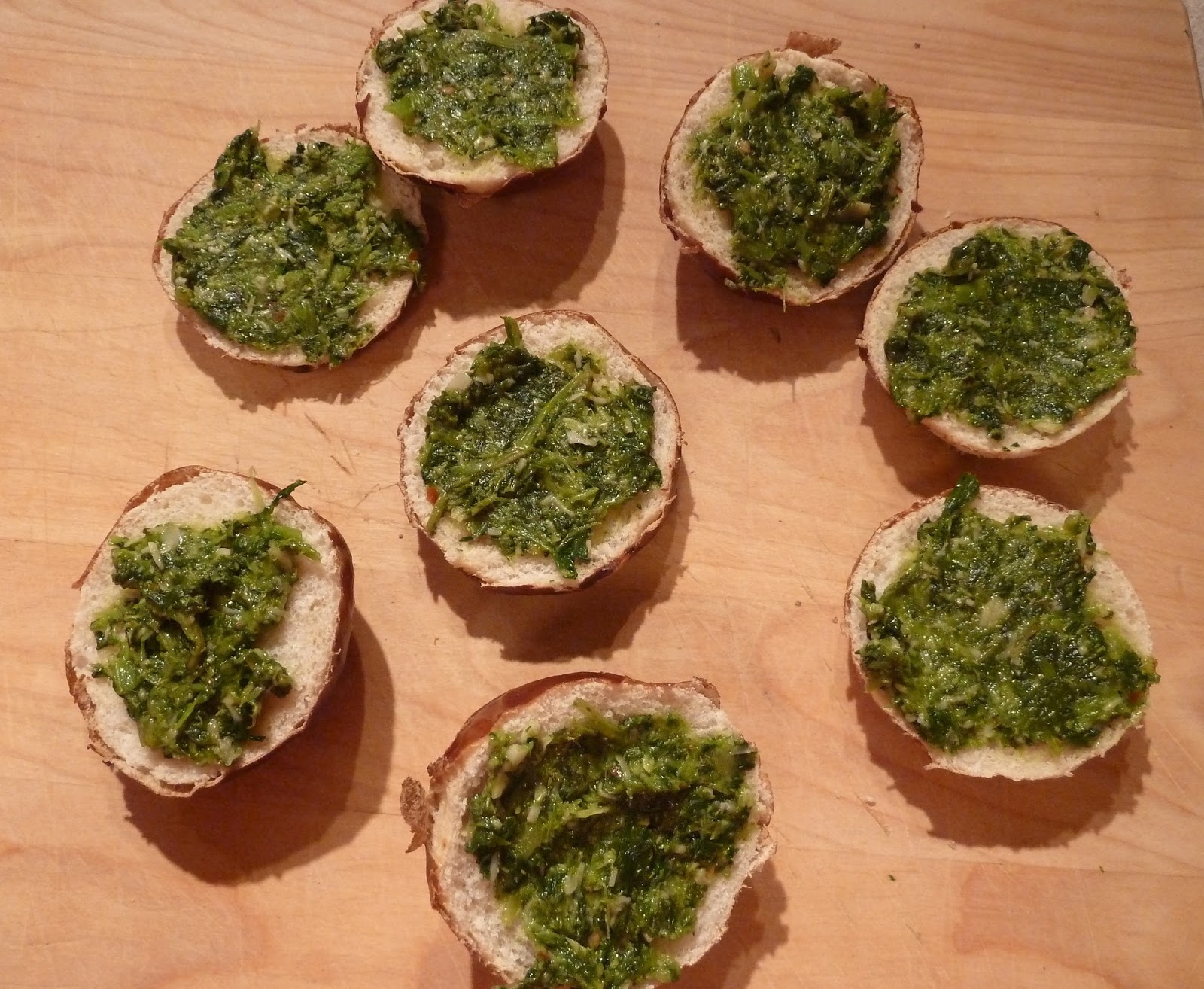
For the pesto, the broccoli raab is briefly cooked in hot water to set the bright green color, then shocked and drained, chopped, and cooked low and slow with a little olive oil, garlic and crushed red pepper flakes until  soft.  The final step is to coarsely puree to a pesto consistency.


About the red pepper flakes - the original recipe called for an entire teaspoon, but the pesto is paired with prosciutto in the original recipe which is a mild, sweet meat. I cut the red pepper in half since I was using spicy sausage.  We were happy with the results - I would call the sliders spicy but not overly so.  Depending on your spice tolerance you may want to start with an even smaller amount of red pepper because you can always add more later.  And about the spicy sausage - you could of course use mild Italian turkey sausage or your favorite variety of pork sausage instead.

The rest of the recipe is really easy - just shape and cook the sausage patties, melt some cheese on top, and assemble.


You can think of the sliders as appetizers, dinner, or party food but don't call them that because it would reveal that you are several iterations behind the trendy curve.  They are now called "Small Plates" when served 2 or 3 at a time and "Plates for Sharing" when served in larger quantities.  (Clearly I've been hanging out in a few too many trendy restaurants lately.)

The Lawyer and I really enjoyed the sliders and yes, they were particularly good with a beer. Apparently the chefs know what they're doing.


Here's how to complete your own personal trip to Trendyville:
1.Have one or both arms tattooed from shoulder to wrist.
2.Assuming you don't already have one, build a nice large rooftop patio on your house complete with speakers and a large flat screen showing old cartoons with the sound turned off.
3.Make a trip to the store to buy several types of hoppy local microbrews with whimsical names, preferably angry ones.
4.Make your sliders.
5.Invite your hippest friends over.  They will see you in a whole new light.  Guaranteed.

printable recipe

Sausage Sliders with Broccoli Rabe Pesto
Makes 10 sliders, approximately 2 ounces each

Note:  Depending on your preference for spiciness, you may want to start with the lower amount of red pepper flakes especially if you are using spicy sausage.

 1 lb broccoli rabe, about one bunch
6 garlic cloves, smashed
¼ cup olive oil
¼ - ½ teaspoon red pepper flakes (see note)
½ cup finely grated Pecorino Romano cheese
2 teaspoons honey
19.75 ounce package hot or sweet Italian turkey sausage links, casings removed
10 slices provolone cheese, cut to fit your slider buns
10 slider buns (white, wheat or pretzel)

For broccoli rabe pesto:  Cook broccoli rabe in a large pot of boiling water until bright green, about 30 seconds; drain and transfer to a bowl of ice water to stop the cooking process.  Drain again and pat with a clean towel to dry.  Cut into 1” pieces.

In the same large pot, combine the oil, garlic, red pepper flakes and broccoli rabe.  Cover and cook over low heat, stirring often, until the broccoli rabe is very soft, about 40-50 minutes.  Transfer to a food processor and pulse to a rough pesto consistency.  Let cool slightly, then mix in Pecorino and honey.  (Pesto can be made up to 3 days ahead, covered and chilled.)

For sliders:  Form the sausage into 10 small patties.  Cook either on a grill or in a frying pan with a small amount of olive oil until browned and fully cooked through, 3-4 minutes per side.  During the last seconds of cooking time put a piece of cheese on each patty to melt.  While the patties are cooking, spread some broccoli rabe pesto on both sides of the buns.  Assemble buns with sausage patties.